

Which Leader Sleeve Material Holds Up Best?
Last Updated: October 26, 2026
Quick Summary
Copper is the most forgiving leader sleeve material in saltwater, gripping harder than aluminum and resisting the slow creep that plagues softer sleeves under constant load. Choose aluminum for easy crimps on mono and light wire, and brass for maximum grip on heavy mono and fluorocarbon.
- Aluminum is the easiest to crimp and lightest, but softer sleeves creep under sustained heavy load.
- Copper work-hardens, so a badly crimped copper sleeve cannot be re-crimped reliably.
- Brass delivers the hardest bite on large-diameter mono but demands a proper bench crimping tool.
- Match sleeve inside diameter to the leader's measured outside diameter, not its stated test rating.
- Rinse rigs in fresh water after every trip and retire any sleeve showing pitting or cracking.
Table of Contents
- How Leader Sleeve Material Decides Your Heavy-Duty Rig
- Aluminum, Copper, or Brass: A Material-by-Material Comparison
- Crimp Sleeves for Fishing Leaders: Oval vs Double-Barrel Designs
- Picking the Right Leader Sleeve Size for Monofilament
- Monofilament Leader Chafe Tubing: Where Sleeves End and Protection Begins
- Ballyhoo Leader Rigging: Matching Sleeve Material to the Bait
- Failure Modes, Crimping Technique, and Saltwater Care
- Build Your Next Heavy-Duty Leader with Titan Guard
- Frequently Asked Questions
How Leader Sleeve Material Decides Your Heavy-Duty Rig
Choosing heavy duty leader sleeve material quietly determines whether your rig survives a long soak or fails on the first run. At Titan Guard Chafe Tubing, we build leader protection for anglers chasing tuna and billfish, and the pattern repeats: the sleeve is the cheapest component in the system and the one most likely to end a fight early.
The sleeve is the metal barrel that clamps your leader to a swivel, hook, or bite trace.
Here's what most guides skip: sleeve material and sleeve size are a matched pair, and getting one right while the other is wrong still fails. Below, we compare aluminum, copper, and brass, then show how to match sleeve inside diameter to your leader, pick a design, and crimp it so the connection holds.
Aluminum, Copper, or Brass: A Material-by-Material Comparison
The short answer: aluminum is the easiest to crimp and the lightest, copper is the most forgiving in saltwater, and brass gives the hardest bite for the most demanding loads. Each has a place on a heavy-duty rig.
You are trading crimp ease against grip strength against corrosion resistance, and no single material wins all three. The table below ties each metal to the leader constructions you actually fish and the failure mode you are most likely to see.
| Material | Crimp Ease | Grip Strength | Corrosion Resistance | Deformation Behavior | Best Leader Match | Primary Risk |
|---|---|---|---|---|---|---|
| Aluminum | Easiest | Moderate | Good with rinsing | Soft, uniform crush; low springback | Monofilament, light single-strand wire | Creep under sustained load; galvanic attack near stainless hardware |
| Copper | Moderate | Strong | Excellent in saltwater | Work-hardens; limited re-crimp | Single-strand wire, multi-strand cable, long soaks | Work-hardening and fatigue cracking if re-crimped |
| Brass | Hardest | Highest | Good, needs care | High resistance; needs full compression | Heavy monofilament, fluorocarbon | Under-crimp or leader nicking at the sleeve edge |
Aluminum: Light, Soft, and Easy to Crimp
Aluminum deforms predictably, making it the friendliest sleeve for monofilament leaders and for anglers building rigs on a rocking boat. It's light, adds little bulk to a spinner leader, and a standard crimping tool seats it cleanly with modest hand pressure.
The trade-off is grip. Aluminum is softer than copper or brass, so it has less bite on hard, large-diameter mono.
Aluminum also sits low on the galvanic series relative to stainless hardware, so in saltwater it can sacrifice itself to protect a swivel or hook eye.
Copper: The Saltwater Workhorse
Copper hits the balance point most offshore anglers want: it grips harder than aluminum, holds up to saltwater when rinsed, and crimps with a firm, even squeeze rather than a delicate one.
For wire leaders and long soaks around reefs and wrecks, copper is our default recommendation.
Copper is also the most compatible sleeve for multi-strand cable and single-strand wire because it deforms around individual strands without cutting them.
Brass: Maximum Bite Without Deforming
Brass is the hardest of the three and delivers the most aggressive grip on large-diameter monofilament. When targeting big tuna on heavy mono and needing every pound of your leader's test rating to translate into holding power, brass gives you the bite.
It is also the least forgiving. Brass resists deformation, so it demands a proper bench crimping tool and a full, deliberate squeeze: under-crimp and it won't seat; over-crimp and you risk nicking the leader inside.
Brass is a poor match for multi-strand cable because its hardness can sever individual strands at the crimp edge.
Crimp Sleeves for Fishing Leaders: Oval vs Double-Barrel Designs
Crimp sleeves for fishing leaders come in two dominant shapes, and the shape matters as much as the metal. Oval sleeves compress into a slim, simplified profile, while double-barrel sleeves fold two walls of metal around the leader for a longer, more gradual grip.
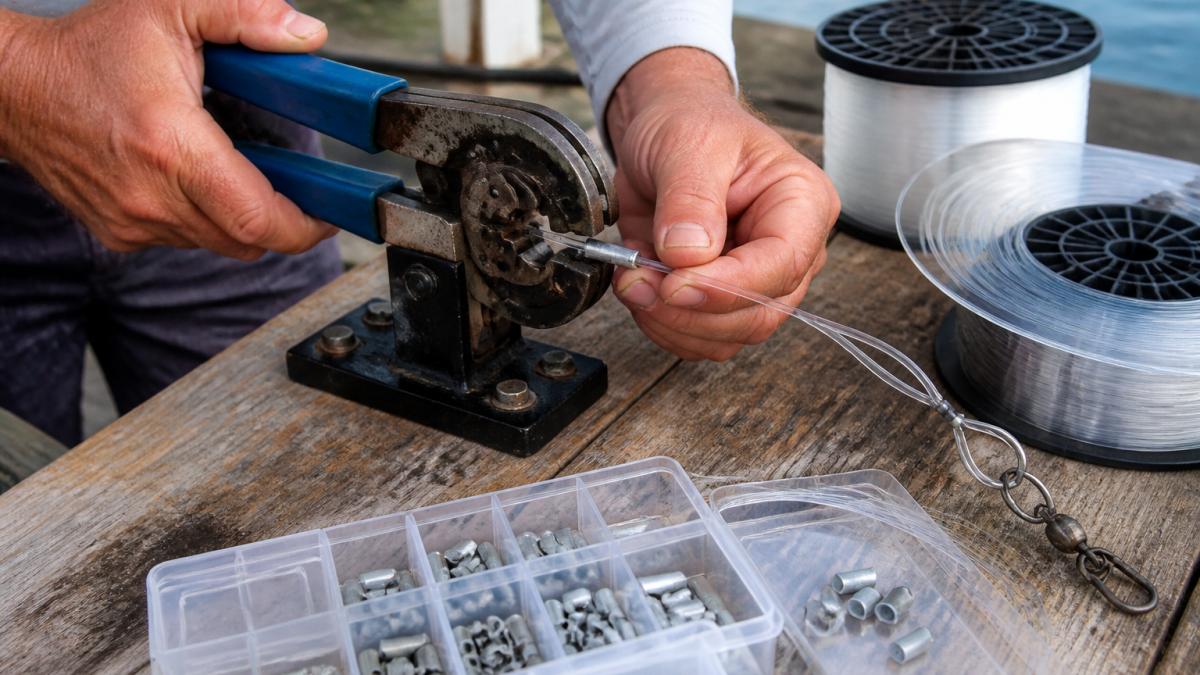
Oval sleeves suit monofilament and lighter wire: they seat fast, sit flush against a swivel, and pass through guides with less fuss.
A practical rule: match the design to the leader's stiffness. Supple mono and small wire take oval sleeves cleanly. Stiff, large-diameter mono and heavy wire leader material benefit from the longer engagement of a double-barrel sleeve.
Picking the Right Leader Sleeve Size for Monofilament
Leader sleeve size for monofilament comes down to one measurement: the sleeve's inside diameter must match the leader's outside diameter, not its stated test rating.
Measure your leader's actual diameter with calipers, then select a sleeve whose inside diameter is a close fit with just enough clearance to slide the leader through. It should slip on with light resistance and compress firmly around the line.
| Leader Diameter | Sleeve Fit | Common Mistake |
|---|---|---|
| Thin mono | Small inside diameter | Using an oversized sleeve that slips |
| Medium mono | Matched inside diameter | Sizing by pound test instead of diameter |
| Heavy mono | Large inside diameter, longer sleeve | Under-crimping a thick, stiff leader |
| Wire leader | Matched to wire gauge | Ignoring strand count and wire diameter |
Sizing by pound test alone is the error we see most.
Monofilament Leader Chafe Tubing: Where Sleeves End and Protection Begins
Monofilament leader chafe tubing solves a problem sleeves cannot: the abrasion that wears a leader down before the crimp ever sees real load.
This is where Titan Guard Chafe Tubing earns its place on a heavy-duty rig.
The pairing is straightforward. Crimp your sleeve for the connection, then run chafe tubing over the leader where it contacts teeth, structure, or the boat. Sleeve and tubing do different jobs, and a complete heavy-duty rig uses both.
Ballyhoo Leader Rigging: Matching Sleeve Material to the Bait
Ballyhoo leader rigging puts specific demands on your sleeve choice because the bait introduces movement and a pin-rig that loads the leader differently than a plain hook set.
For ballyhoo, we lean toward copper or brass sleeves on the main connection, because the constant working of a trolled bait rewards a harder grip.
Match the sleeve to the leader you're running, then protect the section behind the bait with chafe tubing where a bill or teeth will contact it.
Failure Modes, Crimping Technique, and Saltwater Care
Most heavy-duty leader failures trace to one of five causes: a mismatched sleeve size, an under-crimp, a nicked leader inside the sleeve, galvanic corrosion, or fatigue from repeated loading. Every one is preventable, and each has a distinct signature you can learn to spot before it costs you a fish.
| Failure Mode | What You See | Likely Cause | Fix |
|---|---|---|---|
| Slippage | Leader pulls free with a smooth, polished section | Sleeve inside diameter too large or under-crimp | Resize to measured leader diameter; use a matched crimping tool |
| Leader damage | Line breaks just outside the sleeve | Over-crimp or sharp sleeve edge | Use a proper die; deburr or choose a rounded-edge sleeve |
| Corrosion | White or green deposits; pitting on the sleeve | Salt exposure and dissimilar metals | Rinse in fresh water after every trip; retire pitted sleeves |
| Fatigue | Cracked sleeve or broken strands after repeated casts | Work-hardened metal or flex at the crimp | Limit re-crimps; inspect after heavy use |
| Galvanic attack | Aluminum sleeve wasting away near stainless hardware | Dissimilar metal contact in saltwater | Isolate or shorten service interval; inspect frequently |
Crimp technique decides the outcome. Seat the leader fully in the sleeve, position the tool across the full barrel, and apply one firm, complete squeeze.
Build the connection so the sleeve and crimp exceed the leader's stated test rating rather than merely matching it.
Saltwater care is simple and non-negotiable. For guidance on line and knot standards, the IGFA fishing rules and tackle standards set widely followed benchmarks for leader and line classes.
Build Your Next Heavy-Duty Leader with Titan Guard
The material decision should follow the load, the leader, and the water: aluminum for easy crimps and lighter rigs, copper for saltwater durability and wire, brass when maximum grip on heavy mono is the priority.
That last step is where we can help. Titan Guard Chafe Tubing gives your monofilament leaders heavy-duty protection against abrasion and sharp fish teeth, with fast shipping and hassle-free returns so you're ready before the next trip. Get started with Titan Guard Chafe Tubing and build heavy-duty leaders that hold when it counts.
Frequently Asked Questions
What leader sleeve material is best for heavy-duty fishing?
Copper and brass are the usual picks for heavy-duty leaders because they hold their shape under load and resist corrosion in saltwater. Aluminum is lighter and easier to crimp, which suits lighter mono and quick field repairs. Match the material to your line diameter and target species: copper for tuna and billfish rigs, aluminum for smaller leaders where weight matters. Whichever you choose, use a sleeve rated for your pound test and crimp it with a tool sized to the sleeve.
What is the difference between a crimp sleeve and chafe tubing?
A crimp sleeve is the metal fitting that secures your line or wire to a hook, swivel, or leader connection. Chafe tubing is a protective sleeve that slides over a finished leader to shield it from abrasion and sharp teeth. They solve different problems: the crimp holds the connection, the tubing protects the line. Many heavy-duty rigs use both, crimping the connection first and then adding chafe tubing over the section that contacts teeth or structure.
How do I choose the right leader sleeve size for monofilament?
Measure your leader's outside diameter with calipers, then pick a sleeve whose inside diameter matches it closely without forcing. A sleeve that is too small will not slide on; one that is too large will not compress the line evenly and can slip under load. Most manufacturers publish a sleeve chart that maps line diameter and pound test to sleeve size. When you are between two sizes, size up slightly and use a longer sleeve rather than over-crimping a short one.
Does leader sleeve material protect against fish teeth?
The metal crimp sleeve itself does not protect against teeth; that is the job of chafe tubing or a wire leader section. A 400-pound tuna or a wahoo can shear through monofilament in seconds, so heavy-duty rigs add abrasion-resistant tubing over the leader where teeth and bills make contact. Crimp sleeves secure the connections at each end, while chafe tubing guards the line between them. Use both together for tooth-proof leader setups.
How do I know when leader chafe tubing needs to be replaced?
Inspect tubing after every trip for nicks, flat spots, cloudiness, or fraying at the ends. Any visible gouge or section that has gone soft should be cut off and replaced, since damaged tubing concentrates stress on the mono underneath. Saltwater rigs should be rinsed in fresh water and dried before storage to slow corrosion of the crimp sleeves and degradation of the tubing. On charter boats, replace tubing on any rig that took a hard strike or rubbed structure.
Can I use the same sleeve material for wire leaders and monofilament?
Not always. Wire leaders need sleeves sized to the wire gauge and a material hard enough to bite into the strands without cracking, which is why brass and copper are common for wire. Monofilament compresses under crimping, so aluminum sleeves are often used because they deform smoothly around the line. Check the manufacturer's chart for both wire diameter and mono diameter before mixing hardware, and never substitute a mono-rated sleeve on a wire leader.
