

Fishing Gear for Toothy Saltwater Species: 2026 Guide
Last Updated: October 23, 2026
Quick Summary
Fishing gear for toothy saltwater species means matching leader protection to tooth type, not line rating: 40-60 lb mono or wire for bluefish, wire for barracuda, and 30-40 lb fluorocarbon for snook. Pair a 7 to 7.5 foot medium-heavy rod and 20-40 lb braid with chafe tubing seated over the knot.
- Bite-off risk scales with tooth structure and fish size, not pound-test alone.
- Set drag to roughly one-third of leader rating and recheck it after every hard run.
- Slide 2-3 inches of chafe tubing onto the leader before tying any knot.
- Use crimps instead of knots for leaders above 60 pounds, stiff fluorocarbon, and wire.
- Rinse gear in freshwater after every trip and retie any leader showing abrasion.
Table of Contents
- How Toothy Saltwater Species Change Your Gear Choices
- Rod, Reel, and Line Setups That Handle Toothy Saltwater Species
- Choosing Saltwater Fishing Leader Material for Sharp Teeth
- When a Wire Leader for Saltwater Fishing Makes Sense
- Leader Chafe Protection: Rigging Steps and Chafe Tubing
- Lures, Jigs, Hooks, and Terminal Tackle for Toothy Fish
- Saltwater Fishing Gear Maintenance and Post-Fight Checks
- Conclusion
- Frequently Asked Questions
How Toothy Saltwater Species Change Your Gear Choices
Saltwater fishing hit a record 15.5 million anglers in 2026, up 400,000 from the prior year, according to the American Sportfishing Association's 2026 Special Report on Fishing. More rods on the water means more anglers learning the hard way that fishing gear for toothy saltwater species follows different rules than standard inshore tackle. At Titan Guard Chafe Tubing, we build our sleeving around one reality: teeth cut leaders, and cut leaders lose fish.
Toothy saltwater species is the category of fish whose dentition, not their size, dictates how you rig. A 30-inch bluefish can shear 40-pound mono in a single pass. A barracuda takes lures and leaders with equal enthusiasm. The failure point is almost never the hook or the rod. It is the last 12 inches of line in front of the fish's face.
Bite-Off Risk by Species and Size
Bite-off risk scales with tooth structure and fish size, not pound-test alone. Bluefish and mackerel slice cleanly with razor edges. Barracuda and snook apply crushing pressure plus abrasion. Redfish, speckled trout, and flounder present far lower cut risk, which is why inshore setups can run lighter leaders.
| Species | Tooth Type | Cut Risk | Minimum Leader Defense |
|---|---|---|---|
| Bluefish | Razor shearing | High | 40-60 lb mono or wire |
| Barracuda | Razor plus crush | Very high | Wire or heavy mono plus tubing |
| Mackerel | Fine razors | Moderate-high | 30-40 lb mono plus tubing |
| Snook | Abrasive rasp | Moderate | 30-40 lb fluorocarbon |
| Redfish | Crushing pads | Low | 20-30 lb fluorocarbon |
| Speckled trout | Small canines | Low | 15-20 lb fluorocarbon |
| Flounder | Small canines | Low | 15-20 lb fluorocarbon |
That table is the whole argument in miniature: match protection to dentition, not to line rating.
Rod, Reel, and Line Setups That Handle Toothy Saltwater Species
Build the rod and reel around casting distance and drag control, then let the leader absorb the bite. A 7 to 7.5 foot medium-heavy spinning rod covers most boat and shore work; a 9 to 11 foot surf rod handles beach casting.
Match reel size to target class: a 3000 to 4000 spinning reel handles inshore bluefish and mackerel, while a 5000 to 6000 frame suits larger barracuda and heavy current.
Inshore and Shore Fishing Configurations
Inshore fishing around structure, reefs, and tidal current rewards a 7-foot medium-heavy spinning rod, a 4000 reel, 30-pound braid, and a 40-pound leader with chafe protection. Surf fishing pushes toward longer rods for casting distance into the wash, where bluefish and mackerel patrol. Set drag to roughly one-third of leader rating and check it after every hard run.
Choosing Saltwater Fishing Leader Material for Sharp Teeth
Leader choice for toothy saltwater species is a three-way trade-off between bite resistance, abrasion resistance, and presentation.
| Material | Typical Range | Bite Resistance | Abrasion Resistance | Visibility | Best For |
|---|---|---|---|---|---|
| Hard mono | 40-80 lb | Moderate | Moderate | Moderate | Bluefish, mackerel, budget bluefish/mackerel leaders |
| Fluorocarbon | 30-60 lb | Moderate-high | High | Low | Snook, redfish, speckled trout, clear pressured water |
| Single-strand wire | 20-40 lb | Very high | High | High | Barracuda, large bluefish, trolling |
| Coated wire (nylon-coated) | 20-40 lb | Very high | Very high | Moderate-high | Barracuda, kingfish, toothy pelagics |
| Heavy mono plus chafe tubing | 40-80 lb | High | High | Moderate | Bluefish, mackerel, mixed bags |
Monofilament. Mono is the budget workhorse: it stretches to cushion head shakes and protect knots, and it is forgiving to tie.
Wire. Single-strand wire in 20-40 pound-test is the only material that reliably stops a barracuda's razor plus crush bite.
The diameter rule. Bite resistance tracks diameter and hardness, not pound-test alone.
When a Wire Leader for Saltwater Fishing Makes Sense
Wire earns its place when cut-offs outnumber strikes you convert. If bluefish or barracuda are slicing 40-pound mono every few casts, wire leader for saltwater fishing stops the bleeding.
Use wire for:
- Barracuda and large bluefish in high concentrations
- Trolling and casting where fish are aggressive, not leader-shy
- Situations where catch and release is not the priority
Skip wire for snook, speckled trout, and redfish in clear, pressured water. Lure presentation suffers, and strike rates drop. A middle path: heavy mono plus chafe tubing, which we cover next.
Leader Chafe Protection: Rigging Steps and Chafe Tubing
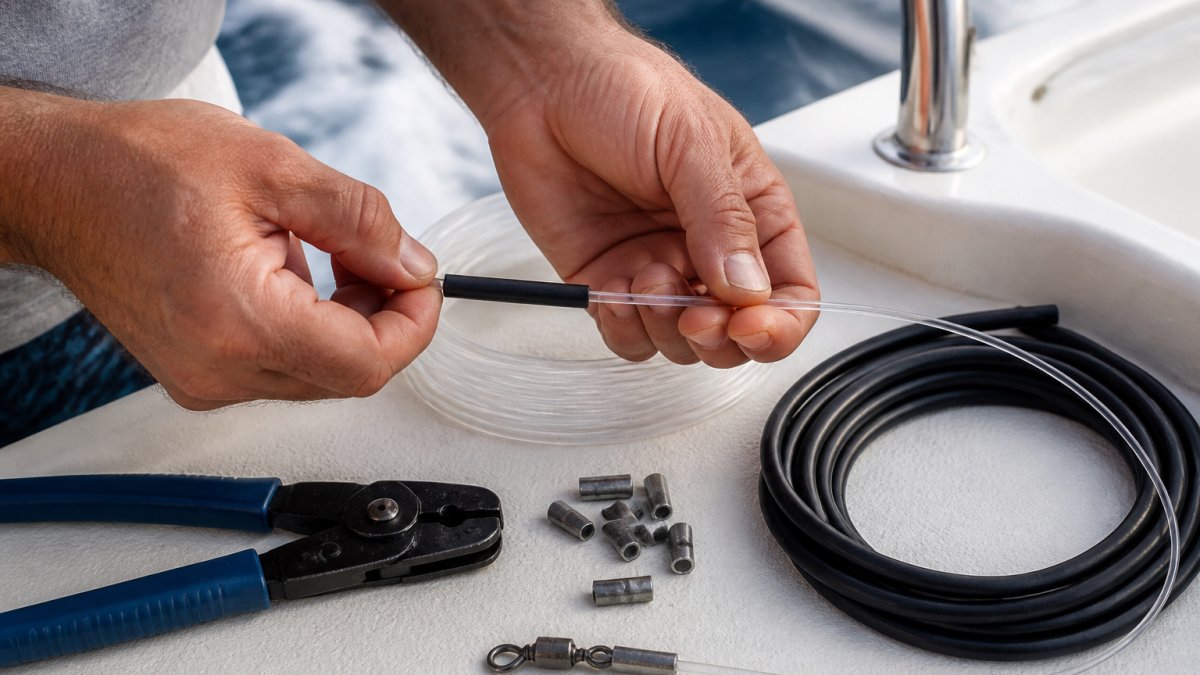
Leader chafe protection is the cheapest insurance in saltwater fishing, and the step most anglers skip. Chafe tubing slides over the leader at the hook or lure end, absorbing abrasion from teeth, reef, and wreck structure while keeping the leader intact.
How Chafe Tubing Actually Works
Tubing works through three mechanisms. First, it spreads point load: a tooth or reef edge that would concentrate force on a single inch of leader instead presses on the tubing's outer wall, distributing stress over a longer section. Second, it shields the knot, the weakest point in any leader system and the first place abrasion causes failure. Third, it adds a sacrificial layer: the tubing wears instead of the leader, and it is far cheaper to replace.
Step-by-Step Rigging With Chafe Tubing
- Cut the leader to length. Leave 18-24 inches of working section in front of the main line connection, plus enough tag to tie. For surf shock leaders, cut 3-6 feet.
- Slide the tubing on first. Thread a 2-3 inch length of chafe tubing onto the leader before tying anything. If you tie first, you cannot add tubing without cutting the leader.
- Choose the connection. For mono and fluoro up to about 60 pounds, a snug knot (improved clinch, or a loop knot for lures) is standard. Above 60 pounds, or with stiff fluoro and wire, a crimp is more reliable: pass the leader through the crimp, through the hook eye or lure ring, back through the crimp, and seat it with a crimping tool. Match crimp size to leader diameter; an undersized crimp cuts the leader and an oversized one slips.
- Seat the tubing over the knot or crimp. Slide the tubing down so it covers the knot or crimp and the first inch of leader in front of it. The tubing should sit flush against the eye or ring, not float loosely behind it.
- Test the connection. Give a firm, steady pull, not a jerk. A knot or crimp that is going to fail should fail on the dock, not on a fish.
- Inspect after every fish. Run the leader through your fingers above and below the tubing. Any roughness means retie or replace.
Knot vs. Crimp: Which to Use
Knots are fine for mono and fluoro in the 20-60 pound range and are easier to tie on a rocking boat. Crimps are better for three situations: leaders above 60 pounds, stiff fluorocarbon that will not seat a knot cleanly, and wire. A poorly tied heavy-mono knot is a common failure point; a correctly sized and seated crimp is more consistent.
Rigging for Wire and Heavy Mono
When barracuda or large bluefish are the target, the terminal rig changes. For wire, use a haywire twist or a crimp at the hook end, then slide a short section of chafe tubing over the wire-to-hook connection if the diameter allows. Keep the terminal section short enough to cast but long enough that the fish's teeth contact tubing rather than bare leader.
Common Rigging Mistakes
- Tying before adding tubing. The tubing has to go on first; there is no way to add it after the knot is seated.
- Tubing too short. A 1-inch section slides out of position; 2-3 inches stays seated over the knot.
- Wrong crimp size. An undersized crimp cuts the leader; an oversized one slips under load.
Lures, Jigs, Hooks, and Terminal Tackle for Toothy Fish
Terminal tackle for toothy fish favors single hooks and durable jigs over trebles that bend. Jig weight depends on depth and tidal current: 1/4 to 1/2 ounce inshore, heavier in deeper structure. Match jig and lure size to forage, and keep hooks sharp.
- Single inline hooks reduce gut-hooking and survive crushing bites
- Jig heads in 1/4 to 1 ounce cover most inshore and shore work
- Heavy split rings and swivels resist corrosion and load
Handling safety matters here: toothy species demand long-nose pliers, a lip grip, and a plan for unhooking fish without fingers near the business end.
Saltwater Fishing Gear Maintenance and Post-Fight Checks
Saltwater fishing gear maintenance starts with a freshwater rinse after every trip and a close look at leader, tubing, and hooks. Corrosion resistance and durability depend on routine, not luck.
What to Inspect After Every Fight
- Run the leader through your fingers for nicks and rough spots
- Check tubing for cracks or slippage at the knot
- Inspect hooks for bent points and rolled tips
Replace worn sections rather than trimming and hoping. Chafe tubing is inexpensive to swap; a lost trophy fish is not.
Conclusion
Every cut-off is a gear decision you can fix before the next trip. Toothy saltwater species punish unprotected leaders, and landing versus losing a hard-fighting fish often comes down to a few inches of protection at the hook end. Titan Guard Chafe Tubing is made in our family-owned factory in the Finger Lakes Region of New York, built to guard monofilament leaders against abrasion and sharp teeth, and shipped fast with hassle-free returns.
Frequently Asked Questions
What leader material is best for fish with sharp teeth?
It depends on the species and how much bite resistance you need. Heavy fluorocarbon in the 60- to 100-pound class handles bluefish, mackerel, and mid-size barracuda while staying subtle in clear water. For larger toothy fish or heavy abrasion around structure, a wire leader for saltwater fishing adds a hard barrier that monofilament cannot match. Many anglers combine a fluorocarbon leader with chafe tubing over the section that contacts teeth and reef, which protects the line without killing lure action.
How do you protect a fishing leader from teeth and abrasion?
Start with a leader rated well above the fish's size class, then add a physical barrier where contact happens. Chafe tubing slides over the monofilament at the hook end and absorbs the sawing action of teeth and the scraping of reefs and wreck structure. Keep knots and crimps smooth, inspect the leader after every fish, and cut back any nicked section before the next cast. A leader chafe protection layer costs little and prevents the failure that ends a fight early.
Should you use wire or heavy monofilament leaders for toothy saltwater species?
Wire wins on pure bite resistance. It will not be severed by teeth the way monofilament can, which matters for bluefish, barracuda, and mackerel. Heavy monofilament and fluorocarbon win on presentation and on fish that shy from visible hardware. One study of longline gear reported that switching from wire to monofilament leaders cut shark catch rates by roughly 41 percent while maintaining catch rates, a reminder that wire changes what bites. Match the choice to the species and water clarity, and use chafe tubing to extend the life of either setup.
How often should you replace a saltwater fishing leader?
Replace or cut back the leader whenever you find nicks, roughness, or cloudiness, which usually means after any fish with teeth or any contact with structure. On a hot bite, check the last 12 to 18 inches above the hook between casts. Even without visible damage, retire leaders after a few outings of heavy use, since salt, sun, and repeated loading weaken monofilament. Carry spare pre-tied leaders so a swap takes a minute, not a layover.
What rod and reel setup works for toothy saltwater fish?
For inshore species such as redfish, speckled trout, snook, and flounder, a 7- to 7-foot-6 medium-light to medium spinning rod paired with a 2500 to 4000 size spinning reel covers most situations. Surf and shore anglers fishing for bluefish and mackerel do better with a 9- to 11-foot surf rod and a 5000 to 8000 reel. Load the reel with 15- to 30-pound braided line, add a fluorocarbon or wire leader, and set the drag to protect the leader on hard runs.
How do you check saltwater fishing gear for damage after a fight?
Run the leader through your fingers for nicks, look for flattened or frayed spots in the braided line, and check hooks for bent points and opened gaps. Wipe down rods and reels with fresh water, then dry them, and add a drop of oil to reel handles and level winds. Inspect chafe tubing for cuts and replace it if it looks chewed. Saltwater fishing gear maintenance after every trip is what keeps drag washers smooth and guides from grooving.
