

Heavy Duty Leader Tubing for Sale: 2026 Buyer's Guide
Table of Contents
- What Heavy Duty Leader Tubing for Sale Actually Protects
- Chafe Protection for Monofilament Leaders: Why It Matters
- Heavy Duty Leader Tubing Diameter Guide
- Material and Construction: Polyethylene, Hybrid Polymer, and 3-Ply Builds
- Coil Length, Diameter, and Working Pressure: Specs That Matter
- How to Rig Ballyhoo for Big Game With Leader Tubing
- Troubleshooting and Environmental Suitability for Offshore Rigs
- Frequently Asked Questions
Last Updated: September 28, 2026
What Heavy Duty Leader Tubing for Sale Actually Protects
Heavy duty leader tubing is a protective sleeve that slides over monofilament or wire leaders to shield them from abrasion, sharp teeth, and big game wear. At Titan Guard Chafe Tubing, we build it for one purpose: helping you land big game fish with absolute confidence.
Chafe Protection for Monofilament Leaders: Why It Matters
Chafe protection for monofilament leaders matters because most leader failures come from friction, not from a fish exceeding your line's breaking strength. A 100-pound class leader can still part against a reef edge, a fish's teeth, or the gunwale.
- Teeth contact: Tuna and wahoo have razor edges that slice clean monofilament
- Structure rub: Reef, wreck, and rig hardware all cause nicks
- Self-abrasion: Leader coils and crosses under load, wearing against itself
- Boat contact: Transom, rod guides, and gaffs all take a toll
Heavy Duty Leader Tubing Diameter Guide
Heavy duty leader tubing diameter must match three things: your leader's measured diameter, the hardware it passes over (crimps, swivels, hooks, chafe springs), and the bend radius under load. Get one wrong and the tubing will not slide on, slips during a fight, or kinks at the worst moment.
| Leader Line Class | Tubing Inside Diameter | Wall Thickness | Typical Use |
|---|---|---|---|
| 80-100 lb mono | 1.0-1.3 mm | 0.4-0.6 mm | Inshore tuna, smaller billfish |
| 130 lb mono | 1.4-1.7 mm | 0.5-0.8 mm | Standard offshore tuna rigs |
| 200 lb mono | 1.8-2.2 mm | 0.7-1.0 mm | Heavy tackle, large tuna |
| 300 lb mono | 2.3-2.8 mm | 0.9-1.3 mm | Wire-to-mono transitions, big game |
| 400 lb mono | 3.0 mm and up | 1.2 mm and up | Extreme heavy tackle applications |
How to Measure Before You Buy
- Calipers, not the label. Measure the leader at three points along its working length. Monofilament is extruded, so diameter drifts from spool to spool and along a single length.
- Add clearance, not slack. Select tubing with an inside diameter roughly 0.1-0.2 mm larger than your measured leader, enough to slide freely without so much gap that the sleeve migrates.
- Check the hardware. Crimps, thimbles, and swivels are often wider than the leader itself. If the tubing has to pass over a crimp, size to the crimp, not the line.
- Test the bend. Bend the assembled rig to the tightest radius it will see in a fight. If the tubing kinks or flattens, step down in wall thickness or use a more flexible polymer.
Inside Diameter vs. Outside Diameter: Which Number Matters
Inside diameter (ID) governs fit; outside diameter (OD) governs bulk, drag, and behavior in a fish's mouth. Two products with the same ID can have very different ODs depending on wall thickness. For trolling and live-bait rigs, a thinner wall keeps the presentation natural; for bottom-fishing and structure work, a thicker wall buys more abrasion margin.
Fit Tolerance: The Failure Mode Nobody Warns You About
A sleeve that is too tight will not slide over the splice, and forcing it can kink the leader before the rig hits the water. A sleeve that is too loose creeps along the leader under load and leaves the vulnerable section exposed. The sweet spot slides by hand with light resistance and stays put when you pull the leader taut.
Matching Diameter to Rig Type
- Chin-weighted ballyhoo: Thin-wall tubing sized just over the leader so the bait swims true.
- Pin rigs: Slightly larger ID to clear the pin and crimp without binding.
- Wire-to-mono transitions: Size to the mono, then secure with brass inserts so the sleeve cannot ride up over the connection.
- Dredge and spreader-bar leaders: Larger ID and thicker wall to survive repeated contact with hardware and other lines.
When in doubt, order two adjacent sizes. A spare coil costs little next to a blown hookup.
Material and Construction: Polyethylene, Hybrid Polymer, and 3-Ply Builds
Most leader tubing is some form of polyethylene, but the label tells you little about how it behaves after a season in the sun or a hundred hookups against a fish's jaw. Resin choice, wall consistency, and layer count determine whether the tubing protects your leader or becomes the weak point.
How the common builds compare offshore:
- Standard polyethylene: Light, flexible, good for most mono leaders up to 200 lb. Best UV resistance when formulated with carbon black or an HALS (hindered amine light stabilizer) package. Without those additives, it chalks and cracks within a season.
- Hybrid polymer: Stiffer, more abrasion-resistant, better for heavy tackle. Trades some flexibility for cut resistance, which matters when a wahoo or kingfish is sawing at the leader.
- 3-ply construction: Multiple layers bonded together to balance a flexible inner bore with a tough outer jacket. The inner layer protects the leader; the outer layer takes the abuse.
- Semi-rigid poly pipe: Used where you need structure and shape retention, such as standoff sections or guides. Not a substitute for flexible chafe tubing.
Why Construction Beats Marketing Labels
A well-made 3-ply sleeve with consistent wall thickness outperforms a thicker single-layer product because it flexes without cracking. Inspect two things before you buy:
- Wall concentricity. If the wall is thicker on one side, the sleeve will kink toward the thin side under load. Roll a cut length between your fingers, it should feel uniform all the way around.
- Bore finish. A rough interior wall abrades the leader you are trying to protect. A smooth bore lets the leader move without scuffing.
Environmental Suitability: UV, Temperature, and Chemistry
UV exposure. Offshore rigs sit in direct sun for hours, and tubing stored on an open boat or in a clear tackle box gets UV year-round. Polyethylene without a UV stabilizer package chalks, crazes, and cracks long before its mechanical limits. Look for UV-stabilized or marine-grade tubing, and replace any sleeve showing a chalky surface or hairline cracks.
How to Tell Good Tubing From Bad
- Flex test: Bend a short length to a tight radius. It should curve smoothly, not crease or whiten at the bend.
- Cut test: Slice a cross-section with a sharp blade. The wall should be uniform, with no voids or visible layer separation.
- Sun test: Leave a sample on a sunny dock or dashboard for a few weeks. If it chalks or cracks, it will do the same on your rig.
- Smell test: A strong chemical or solvent odor can indicate low-grade resin or residual processing chemicals.
For anglers running a hose reel or washdown system, the same principles apply to any flexible connector or water line on board: match the material to the environment, and replace anything that shows cracking or stiffness.
Coil Length, Diameter, and Working Pressure: Specs That Matter
Coil length determines how many leaders you can protect per purchase, and working pressure tells you what the tubing handles under load.
Match these specs to your fishing:
- Coil length:
- Diameter: Governed by line class, as covered above
- Working pressure: Choose tubing rated well above your drag setting, not just your line class
- Burst strength: The failure point under extreme load; higher is safer but often stiffer
- Flow rate: Relevant for any tubing used in live bait or water delivery systems
How to Rig Ballyhoo for Big Game With Leader Tubing
Rigging ballyhoo with leader tubing starts with a clean, straight bait and a leader sized to your target species. The tubing protects the leader section running through the bait's head and along the shank, where teeth and structure do the most damage.
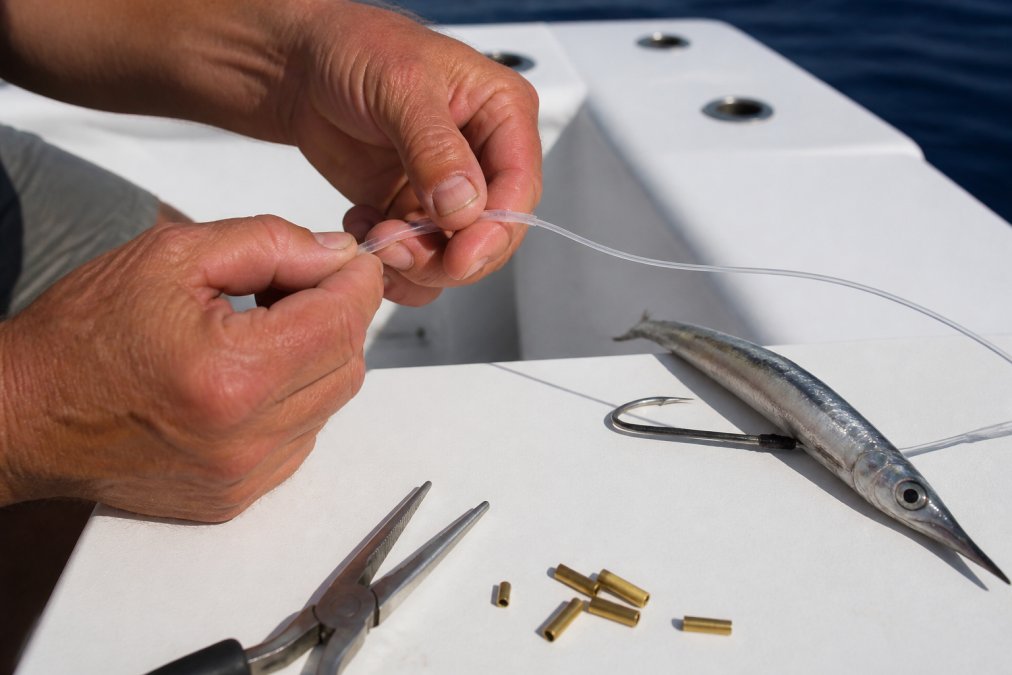
Follow these steps:
- Inspect the bait. A ballyhoo with a soft or torn head will not swim true, no matter how good your rig is.
- Measure your leader. Cut a length suited to your target species and the conditions.
- Slide the tubing on. Feed the leader through the sleeve before you attach terminal hardware.
- Position the sleeve. Center it over the section that runs through the bait and along the shank.
- Secure with brass inserts or crimps. Brass inserts and crimps hold the tubing in place without cutting the leader.
- Attach the hook. Use a proper pin rig or chin rig depending on how you want the bait to swim.
- Test the swim. Drag the bait alongside the boat before you put it out.
Troubleshooting and Environmental Suitability for Offshore Rigs
Offshore conditions punish gear in ways inshore fishing never does. Salt, UV, heat, and constant flexing all work against your rig, and leader tubing has to survive all of it.
Common problems and fixes:
- Tubing slips during a fight: Switch to brass inserts or a proper crimp instead of relying on friction
- Leader kinks under the sleeve: You are using tubing that is too stiff for the bend radius; step down in stiffness
- Sleeve cracks after a season: UV damage; store rigs out of direct sun and replace tubing each season
- Salt buildup inside the bore: Rinse rigs in fresh water after every trip
- Tubing will not slide over the splice: Diameter mismatch; measure and resize
Frequently Asked Questions
What is the purpose of leader tubing in big game fishing?
Leader tubing is a heavy duty sleeve that slides over your monofilament leader to shield it from abrasion. It protects against sharp fish teeth, reef edges, and boat hardware that can nick or cut the line. In practice, it adds a sacrificial layer so the leader keeps its full working pressure when a tuna or billfish runs. Anglers targeting big game use it on wind-on leaders, ballyhoo rigs, and any setup where the leader contacts rough surfaces.
How do you choose the right diameter for leader chafe tubing?
Match the tubing's inside diameter to your leader's outside diameter plus a small clearance so it slides on without binding. If the fit is too loose, water and debris get in; too tight, and you cannot install it quickly. A heavy duty leader tubing diameter guide helps you cross-reference leader size, tubing ID, and coil length before you buy.
Is heavy duty leader tubing compatible with monofilament leaders?
Yes. Heavy duty leader tubing for sale is designed specifically for monofilament leaders used in saltwater sport fishing. It slides over mono, and with brass inserts or male to female fittings, it also works with wind-on leader systems. Check the tubing's inner diameter against your mono's diameter; most products list a range.
How does heavy duty tubing prevent line breakage from fish teeth?
Fish teeth create sharp edges that saw through monofilament under tension. Heavy duty tubing adds a semi-rigid, kink-resistant layer between the teeth and the leader. When a fish bites down, the tubing absorbs the abrasion instead of the mono. This keeps the leader's burst strength intact at the critical moment.