

Is Heavy Duty Tubing Worth It? A 2026 Guide
Table of Contents
- Is Heavy Duty Tubing Worth It? The Cost vs. Value Breakdown
- Chafe Tubing vs. Standard Tubing: Key Differences
- How to Rig Chafe Tubing on Monofilament Leaders
- Monofilament Leader Abrasion Protection: What Actually Works
- Fishing Leader Maintenance: Inspection and Replacement
- Weight, Speed, and Handling Trade-Offs
- Alternatives to Heavy Duty Tubing
- Frequently Asked Questions
Last Updated: October 9, 2026
Is Heavy Duty Tubing Worth It? The Cost vs. Value Breakdown
Heavy duty tubing is worth it when the cost of a single failure exceeds the cost of the protection. That sounds obvious, but most anglers never run the numbers. Let's do that here, because the answer changes depending on how you fish.
What You Actually Pay For
You are buying abrasion resistance, not strength. A heavy-duty tube does not make your 80-pound leader stronger; it keeps that leader from being worn down to 40 pounds by teeth, gills, and boat hardware.
The material matters more than the marketing. Dense woven sleeving holds up to repeated contact. Thin wall tubing compresses under load and offers little protection where it counts.
That difference is the entire product. You are paying for the wall, the weave, and the consistency of the fit over your mono.
The Real Cost Math
Heavy duty chafe tubing typically costs a few dollars per foot, while standard thin-wall tubing runs less than half that. A typical offshore leader uses 3 to 6 feet of tubing. So the upgrade from standard to heavy duty usually adds somewhere between $5 and $20 per leader.
Now compare that to what a failure costs:
- A single bluewater trolling lure: $15 to $60
- A rigged ballyhoo or skirted bait: $10 to $30
- A charter trip: $500 to $2,500 per day
- A lost trophy fish that would have won a tournament: potentially thousands in prize money and entry fees
If heavy duty tubing prevents even one lost fish per season, it pays for itself many times over. The math is even more lopsided for charter captains, where a client who loses a fish to preventable gear failure may not book again.
When It Saves You Money
The value shows up fastest in three situations:
- Trolling fast for tuna and billfish, where friction and heat build on the leader
- Fishing structure like reefs and wrecks, where the leader drags across sharp edges
- Running wind-on leaders, where the splice is the weakest, most exposed point
If none of those describe your fishing, a standard leader may serve you fine. But if you fish any of those conditions even occasionally, the cost of upgrading is trivial compared to the downside.
A Simple Decision Framework
Ask yourself three questions:
- How often do you lose fish to leader failure? If it happens more than once a season, heavy duty tubing is almost certainly worth it.
- What does a lost fish cost you? If you are fishing recreationally and losing a fish is just a story, standard tubing may be enough. If you are chartering, competing, or chasing once-in-a-lifetime fish, upgrade.
- How abrasive is your fishery? Clean open water with few structure contacts may not justify heavy duty. Reefs, wrecks, and toothy critters do.
If you answered "often," "a lot," or "very" to any of those, heavy duty tubing is the better economic choice. If you answered "rarely," "not much," and "not really," save your money and stick with standard.
Chafe Tubing vs. Standard Tubing: Key Differences
Chafe tubing protects the leader at the point of contact. Standard tubing just covers it.
Standard tubing is typically a thin, smooth sleeve used to tidy a connection or add light protection. It handles minor wear and looks clean, but it compresses and thins under real load.
Chafe tubing is built for abrasion.
| Feature | Standard Tubing | Chafe Tubing |
|---|---|---|
| Wall thickness | Thin | Heavy-duty |
| Primary job | Cover the connection | Resist abrasion |
| Best for | Light tackle, clean water | Tuna, billfish, structure |
| Survives sharp teeth | Poorly | Well |
| Handles fast trolling | Limited | Yes |
| Typical use | Occasional | Serious offshore |
The takeaway: if your leader never touches anything abrasive, standard tubing is enough.
How to Rig Chafe Tubing on Monofilament Leaders
Rigging chafe tubing takes a few minutes and no special tools beyond what's already in your leader wallet. The goal is simple: slide the tube over the section of mono that takes the abuse, and lock it in place so it stays put during the fight.
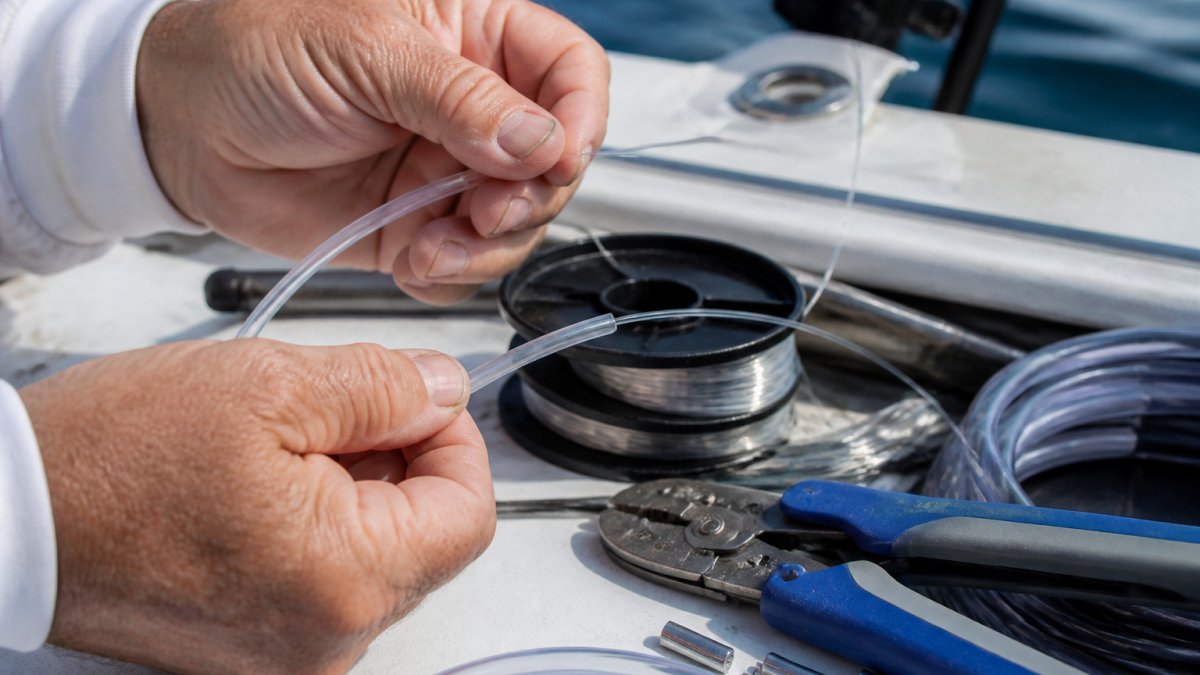
Step-by-Step Installation
- Cut your monofilament leader to length for the target species.
- Slide the chafe tubing onto the leader before you tie or crimp the terminal end.
- Position the tubing over the section that contacts teeth, gills, or structure.
- Secure both ends so the tube cannot slide during a run.
- Wet the mono before tightening any crimp or knot.
- Test the fit by hand, then check it again after the first fish.
Common Rigging Mistakes
The most common mistake is rigging the tube too short. If it doesn't cover the full contact zone, the mono wears through right at the tube's edge.
Other frequent errors:
- Crimping the tube so tight it crushes the mono underneath
- Leaving the tube loose so it slides up the leader mid-fight
- Skipping the wet-down before tightening, which adds friction heat
- Reusing a tube that's already nicked or stretched
Each of these turns your protection into a failure point. Rig it once, rig it right.
Monofilament Leader Abrasion Protection: What Actually Works
Monofilament leader abrasion protection works when it addresses the specific wear your fishing creates. There is no universal fix, only the right fix for your conditions.
Three things drive leader failure: sharp teeth, rough structure, and heat from friction at speed. Good protection handles all three.
- Teeth: dense, heavy-wall sleeving that resists being cut
- Structure: a tube long enough to cover the full drag zone
- Friction and heat: smooth material that doesn't grab or melt under speed
This is where a purpose-built product beats a generic sleeve. Titan Guard Chafe Tubing is engineered specifically for monofilament leaders under offshore loads, with a heavy-duty sleeving design that guards against sharp teeth and abrasion.
Fishing Leader Maintenance: Inspection and Replacement
Fishing leader maintenance is what decides whether your protection actually holds up. Chafe tubing buys you margin, but only if you inspect the leader underneath it.
After every serious fish, check three things:
- The mono where the tube ends, since that's where wear concentrates
- The tube itself for nicks, cracks, or stretching
- The connection points for any sign of slippage
Replace the leader when you find flattening, cloudiness, or roughness. Replace the tubing when it shows damage, because a compromised tube protects nothing.
A simple rule: if you wouldn't trust the leader on a big fish, don't fish it. Cutting off a few feet of mono is cheap. Losing the fish of the season is not.
Weight, Speed, and Handling Trade-Offs
Heavy-duty tubing adds a small amount of weight and drag to the leader, and that has real effects at speed.
The trade-offs to weigh:
- Weight: heavier tubing can affect how a bait or lure tracks, especially on lighter setups
- Speed: at high trolling speeds, extra drag and friction matter more, so smooth material and a snug fit help
- Handling: a stiffer, heavier leader is less forgiving on the cast and in the wash
For offshore trolling, these trade-offs are usually minor and worth it. For light tackle or finesse presentations, they can matter enough that a thinner standard tube is the better call.
Match the tubing to the job. Heavy-duty protection on a heavy-tackle leader is a clean win. The same tubing on a light inshore rig is overkill that changes how the bait swims.
Alternatives to Heavy Duty Tubing
Heavy-duty tubing is not the only way to protect a leader. It's just the most direct one. But before you commit, it's worth comparing it against the other common options so you can pick the right tool for your specific failure pattern.
The Main Alternatives
- Thicker leader material: going up in mono diameter adds abrasion resistance, but it also adds bulk and cost, and it doesn't stop teeth. A 100-pound mono is harder to cut than 80-pound, but a wahoo or kingfish will still slice it.
- Wire leaders: excellent against teeth, but they change the presentation and can be a dealbreaker for line-shy fish like tuna and billfish. Wire also kinks and needs frequent replacement.
- Fluorocarbon leaders: low visibility and decent abrasion resistance, but still vulnerable to sharp teeth and structure. Fluorocarbon is harder than mono, but it is not tooth-proof.
- Tire liners (for bicycle and motorcycle tubes): if you are asking about heavy duty tubing for tires rather than fishing leaders, the alternatives are tire liners, sealant, and tubeless setups. Tire liners add puncture protection between the tube and tire, but they add weight and can shift. Sealant plugs small punctures but not sidewall cuts. Tubeless eliminates the tube entirely but requires compatible rims and more maintenance.
- Shorter leaders with frequent replacement: cheap and simple, but you lose fish to failures between changes.
When Each Option Wins
| Option | Best For | Weakness |
|---|---|---|
| Heavy duty chafe tubing | Tuna, billfish, structure, fast trolling | Adds slight weight and drag |
| Thicker mono | Light abrasion, clean water | Doesn't stop teeth |
| Wire | Tooth-heavy species (kingfish, wahoo) | Kills presentation, kinks |
| Fluorocarbon | Line-shy fish, moderate abrasion | Not tooth-proof |
| Tire liners (tire use) | Commuting, moderate puncture risk | Weight, can shift |
| Tubeless (tire use) | Performance, fewer flats | Setup complexity, maintenance |
How to Choose
Start with your most common failure mode. If you are getting cut off by teeth, wire or heavy duty tubing is the answer. If you are wearing through on structure, heavy duty tubing or thicker mono works.
If you are just a weekend angler, you don't need every option. Pick the one that solves your specific failure pattern. For most offshore anglers, heavy duty chafe tubing is the best balance of protection, presentation, and cost.
Frequently Asked Questions
Is heavy-duty chafe tubing worth it for big-game fishing?
For anglers targeting tuna, billfish, or other toothy species, heavy duty tubing is worth it because it protects monofilament leaders from abrasion and sharp teeth. A single lost trophy fish can cost more than the tubing itself. If you fish abrasive structure or fight fish near the boat, the protection pays for itself. Weekend anglers may not need it, but anyone chasing big game should use it.
How does chafe tubing compare with standard tubing?
Chafe tubing has a thicker wall and tougher construction than standard tubing. Standard tubing is often thinner and meant for light abrasion, while chafe tubing is built to resist sharp teeth and heavy wear. The trade-off is slightly more weight and stiffness. For monofilament leader abrasion protection in saltwater, chafe tubing lasts longer and holds up better against repeated contact.
Does chafe tubing protect monofilament leaders from fish teeth?
Yes. Chafe tubing creates a physical barrier between the leader and the fish's teeth. When a fish bites or rubs against the leader, the tubing takes the damage instead of the monofilament. This is especially important for species with sharp teeth like wahoo or kingfish. The tubing does not make the leader unbreakable, but it reduces the chance of a bite-off.
Can heavy-duty tubing make a fishing leader less flexible?
Heavy duty tubing adds some stiffness, but it does not ruin action if sized correctly. Choose tubing that matches your leader diameter and use the shortest length that covers the critical wear zone. For most big game rigs, the added stiffness is minimal and does not affect bait presentation. If you need maximum flexibility, use a shorter section of tubing.
The real challenge isn't choosing between protection and performance. It's rigging your leaders so they survive the fish you actually chase. Titan Guard Chafe Tubing is built for exactly that: heavy-duty sleeving that guards against sharp teeth and abrasion, 100% made in the USA in our family-owned factory, with fast shipping and hassle-free returns. Shop Titan Guard Chafe Tubing and rig your leaders to land the fish instead of losing them.