

Leader Protection Alternatives to Fish USA
Table of Contents
- What Leader Protection Actually Means for Your Fishing
- Chafe Tubing vs Wire Leader: Which Protects Your Monofilament
- Monofilament Leader Abrasion Protection: Material Comparison
- How to Size Fishing Chafe Tubing for Your Rig
- Fishing Leader Protection Sleeves: Installation and Durability
- Species-Specific Leader Protection: What Works Where
- Cost, Durability, and Real-World Performance
- Conclusion
- Frequently Asked Questions
Last Updated: October 8, 2026
What Leader Protection Actually Means for Your Fishing
Leader protection shields your monofilament leader from abrasion, sharp teeth, and environmental wear.
Without protection, your leader fails when it matters most: a 400-pound tuna's gill plates can shred monofilament in seconds, and reef rocks, wreck edges, and sharp teeth all work against you. Leader protection alternatives insert a durable barrier between your main line and whatever threatens to cut it.
Chafe Tubing vs Wire Leader: Which Protects Your Monofilament
Chafe tubing and wire leaders represent two protection philosophies that excel in different scenarios.
When Chafe Tubing Wins
Chafe tubing preserves castability and sensitivity. The sleeving wraps around your monofilament without replacing it, so you keep the flexibility and feel of your original setup.
Chafe tubing shines when you fish structure and need to detect bites and cast precisely. Wind-on leader anglers benefit most because the tubing installs over the splice without disrupting the system.
When Wire Leaders Make Sense
Wire leaders offer maximum bite protection for toothy species. A stainless steel bite trace won't fray when a shark or barracuda clamps down.
Wire creates a visible connection point and is stiffer than monofilament, affecting casting distance and presentation.
The trade-off is rigidity: wire doesn't move like monofilament, lure action changes, and casting distance decreases.
Monofilament Leader Abrasion Protection: Material Comparison
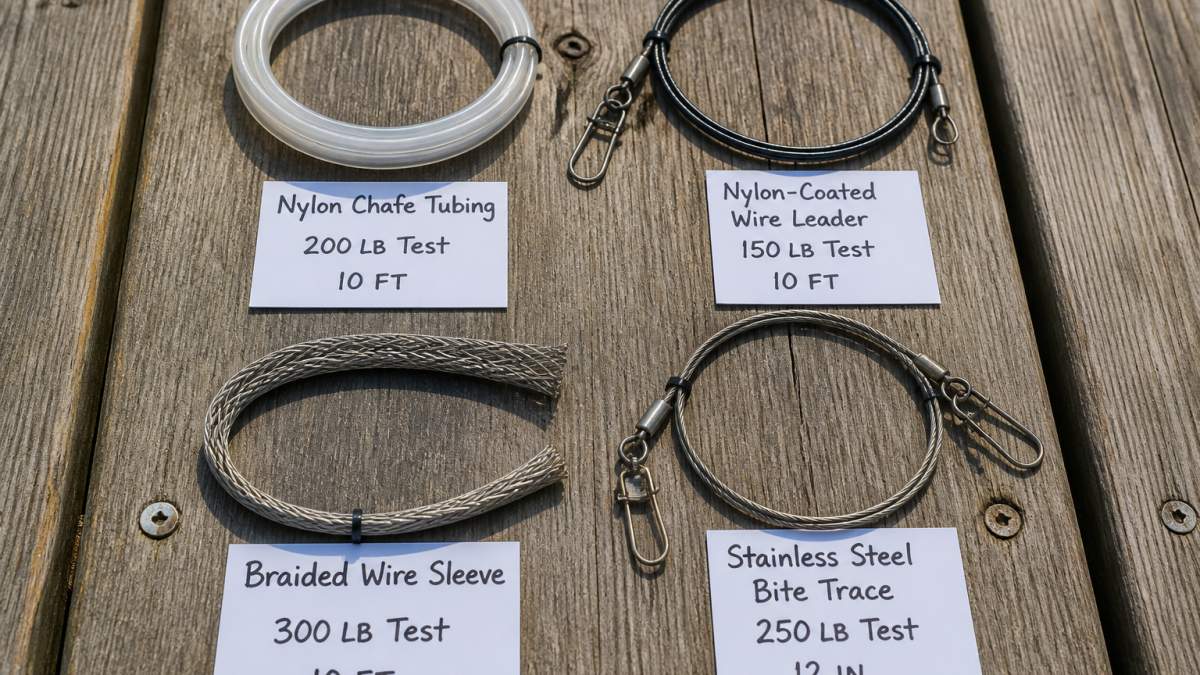
The table below compares the four options you'll see on shelves and in online tackle listings by construction, strength, and cost per leader.
| Protection Type | Typical Construction | Common Breaking Strengths | Standard Lengths | Coating / Finish | Typical Pack Size | Relative Cost per Leader |
|---|---|---|---|---|---|---|
| Nylon chafe tubing | Extruded nylon or nylon-over-braid sleeve | Not rated as a standalone line; protects the leader beneath | Sold by the foot, often 3-10 ft coils | Smooth nylon exterior | 1 coil | Lowest |
| Nylon-coated wire | Single-strand wire core with nylon jacket | 30-90 lb test classes | 1-3 ft pre-cut, or by the foot | Bonded nylon jacket | 3-10 leaders | Low to moderate |
| Braided wire sleeve | Interlocked fine wire strands, hollow core | 40-150 lb test classes | 1-3 ft pre-cut | Bare braid or light coating | 3-10 leaders | Moderate |
| Stainless steel bite trace | Solid or 7-strand stainless, sometimes coated | 60-200 lb test classes | 1-3 ft pre-cut | Bare, or nylon/fluorocarbon coated | 2-5 leaders | Highest |
Use these numbers as a starting point, not a rule. Manufacturers publish their own ratings, and the leader you attach matters as much as the protection itself.
How to Read the Specs
Breaking strength tells you what the protection survives in a straight pull, not against teeth, gill plates, or rock.
Length determines coverage. A 12-inch pre-cut covers the splice and first few inches of leader; a 36-inch pre-cut covers the entire leader on most inshore and light offshore rigs.
Coating changes visibility and durability: bare stainless is most visible and corrosion-resistant, nylon-coated wire is less visible but less durable at the coating edges, and braided sleeves sit in between.
Cost per Leader, Not Cost per Pack
The sticker price on bite traces looks high next to a coil of chafe tubing, but per-leader math flips that impression.
- A coil of nylon chafe tubing yields 10-20 leader sections, making its per-leader cost usually the lowest.
- A pack of three pre-cut coated wire leaders costs more per leader but is ready to fish with no cutting or positioning.
- A pack of two stainless bite traces has the highest per-leader cost, but if you fish 100+ days a year and reuse the trace, per-trip cost drops below disposable options.
Failure Modes to Watch
Each material fails predictably. Knowing the failure mode tells you what to inspect between trips.
- Nylon chafe tubing fails when the nylon abrades through and exposes the leader. Inspect where it contacts rod guides and structure, and replace when you can see the leader through the sleeve.
- Nylon-coated wire fails at the coating edges where nylon ends and bare wire begins. Seal or inspect those edges every trip.
- Braided wire sleeves fail when strands separate or salt crystals work between them and accelerate corrosion. Rinse after every saltwater trip and replace when frayed.
When to Choose Each
- Chafe tubing when you want to keep your existing leader, need castability, and fish mixed structure where abrasion is the main threat.
- Nylon-coated wire for a balance of bite protection and reduced visibility on species that mix sharp teeth with open-water presentations.
- Braided wire sleeves when you need flexibility and bite protection together, and will rinse and inspect after every trip.
How to Size Fishing Chafe Tubing for Your Rig
Sizing chafe tubing correctly prevents slippage and covers the right areas.
Measure your leader diameter where you'll install protection. Your tubing internal diameter should match or slightly exceed your leader diameter.
Position protection where contact actually occurs.
Length matters too: a section that covers the critical abrasion zone is often sufficient, while longer sections can add weight and reduce sensitivity.
Fishing Leader Protection Sleeves: Installation and Durability
Installation on Wind-On Leaders
Wind-on leaders require careful tubing placement because the splice is your connection point.
Once positioned, the tubing stays in place through friction, no adhesive or fasteners. Adjustments are easy: change your leader length, remove the old tubing, and install new protection on the updated splice.
Test the fit by gently pulling the tubing along the leader, it should move slightly but not slip freely.
Saltwater Durability and Corrosion Resistance
Saltwater demands corrosion-resistant materials. Braided wire sleeves require rinsing after each trip to prevent salt accumulation between strands.
UV exposure can degrade nylon over time. Storing rigged leaders in a cool, dark place can help extend tubing life.
Rinse leader protection with fresh water after saltwater trips. Salt crystals trapped in braided structures can accelerate corrosion, and a quick rinse can help prevent premature failure.
Species-Specific Leader Protection: What Works Where
Species-specific advice only helps if it tells you what to rig, how long, and how thick. The recommendations below map protection choice to target species, water type, and fishing method.
Tuna and Billfish
Tuna and billfish punish weak connections. Their gill plates are rough, their runs are long, and the leader spends time against the rod guide during the fight.
Tuna (bluefin, yellowfin, bigeye)
- Leader length: 6-15 ft of mono or fluorocarbon, with protection covering the splice and first 3-4 inches of leader.
- Leader diameter: 80-200 lb test depending on fish size and method (chunking, jigging, trolling).
- Protection: nylon-coated wire or braided wire sleeve over the splice. Chafe tubing works in open water where abrasion is limited to the rod guide.
Billfish (marlin, sailfish)
- Leader length: 12-30 ft, often with a wind-on section.
- Leader diameter: 100-400 lb test depending on species and bait vs. lure fishing.
- Protection: stainless steel bite trace at the lure or bait end, with the rest of the leader bare for action.
Reef and Wreck Fishing
Reef and wreck fishing is an abrasion problem first and a bite problem second. Coral, barnacles, broken metal, and jagged rock all cut leaders.
Grouper and snapper
- Leader length: 3-6 ft, short enough to keep bait near structure without giving fish a long run into the rocks.
- Leader diameter: 50-130 lb test depending on species and structure density.
- Protection: chafe tubing over the section that contacts structure during retrieve and fight.
Wreck fishing for amberjack, kingfish, and similar
- Leader length: 4-10 ft.
- Leader diameter: 60-150 lb test.
Sharks and Other Toothy Species
Sharks, barracuda, and large bluefish cut through monofilament and fluorocarbon with ease. Here, bite protection is non-negotiable.
- Leader length: 3-10 ft depending on species and boat vs. shore fishing.
- Leader diameter: 80-200 lb test for the bite trace, with heavier mono or fluorocarbon above it if you need casting distance.
- Protection: stainless steel bite trace, crimped with corrosion-resistant sleeves.
Inshore and Light Tackle
Speckled trout, redfish, flounder, and similar inshore species rarely require bite protection. The threats are oyster bars, dock pilings, and light abrasion.
- Leader length: 12-24 inches of fluorocarbon, often tied directly to braided main line.
- Leader diameter: 15-30 lb test.
- Protection: light nylon chafe tubing where the leader contacts oyster bars or dock structure. In most inshore situations, no added protection is needed.
Freshwater Applications
Northern pike, muskellunge, and pickerel have sharp teeth and will cut light leaders. Bass, walleye, and panfish generally don't require bite protection.
- Pike and muskie: 6-12 inch wire or heavy fluorocarbon leaders in the 30-80 lb test range. Braided wire sleeves work well because they preserve lure action.
- Bass and walleye: 12-24 inch fluorocarbon leaders in the 8-20 lb test range. Chafe tubing only if you fish heavy cover.
- Panfish: no leader protection needed in most situations.
A Simple Decision Framework
Work through these questions in order:
- Does the target species have teeth that can cut monofilament? If yes, you need bite protection, wire or stainless bite trace. If no, move to question 2.
- Will the leader contact abrasive structure during the fight? If yes, add chafe tubing or a braided sleeve at the contact zone. If no, move to question 3.
- Is the fish leader-shy? If yes, use the lightest protection that solves the problem, or none at all. If no, choose based on durability and cost.
- How many days a year do you fish this setup? Fewer than 20 days, favor disposable options like chafe tubing. More than 50 days, favor reusable options like stainless bite trace.
Cost, Durability, and Real-World Performance
Leader protection alternatives vary significantly in cost and longevity.
Chafe tubing can offer good value for many anglers.
Real-world performance shows proper installation matters. Understanding your setup, leader diameter, connection method, and target species matters.
Titan Guard Chafe Tubing is engineered for heavy-duty saltwater use. It resists UV degradation and slides easily over standard monofilament leaders.
| Protection Type | Best For | Durability | Installation | Cost |
|---|---|---|---|---|
| Chafe Tubing | Wind-on leaders, versatile use | 1-2 seasons | 30 seconds | Low |
| Braided Wire Sleeves | Structure fishing, flexibility needed | 1-2 seasons | 2 minutes | Medium |
| Stainless Steel Bite Trace | Toothy species, maximum protection | 3+ seasons | 5 minutes (crimping) | High |
| Nylon-Coated Wire | Mixed species, balanced approach | 2-3 seasons | 3 minutes | Medium-High |
Conclusion
Leader protection isn't optional for serious saltwater anglers. Choosing between chafe tubing, braided sleeves, and wire leaders depends on your specific fishing situation, target species, and rig setup. Fast shipping and hassle-free returns mean you can focus on what matters: getting your rig right before the next trip. Shop Titan Guard Chafe Tubing and experience the difference quality protection makes.
Frequently Asked Questions
Is chafe tubing better than a wire leader?
Chafe tubing and wire leaders serve different purposes. Chafe tubing protects monofilament leaders from abrasion against rough surfaces and fish teeth while maintaining the leader's flexibility and bite sensitivity. Wire leaders offer stronger bite protection but reduce sensitivity and are heavier. For tuna and billfish using monofilament, chafe tubing is often preferred because it preserves the leader's strength and handling characteristics while still guarding against sharp teeth and reef damage.
What size chafe tubing should I use for a fishing leader?
Size your chafe tubing to match your leader diameter with a snug fit, typically 1-2 mm larger than your monofilament's outer diameter. The tubing should slide smoothly over your leader without gaps or excessive looseness. Verify compatibility with your splices and crimp connections.
How do you protect a monofilament leader from sharp fish teeth?
Position chafe tubing over the final 12-24 inches of your monofilament leader where toothy fish strike, and maintain proper leader strength. Chafe tubing guards against abrasion during the fight. For offshore work, the tubing protects the splice and leader body.
When should you use chafe tubing on a fishing leader?
Use chafe tubing whenever your monofilament leader faces abrasion: fishing reefs, wrecks, rocky structure, or any environment where the line contacts sharp surfaces. It's essential for tuna and billfish where the fight can last hours and the line rubs against the fish's head and gill covers. Wind-on leader systems benefit from tubing at splice points to prevent wear during the splice-to-line transition. Weekend anglers and professionals alike can benefit from using it.