

Do You Really Need Leader Protection for Saltwater Fishing?
Last Updated: October 25, 2026
Quick Summary
Leader protection is the practice of shielding the terminal end of your line from abrasion, teeth, and structure so the weakest link in your tackle does not cost you a fish of a lifetime. Fluorocarbon is the best all-around leader material for most saltwater fishing, while wire is the only real answer when teeth are the primary threat.
- Abrasion damage is cumulative and invisible, so run your fingers along the last few feet after every fish.
- Fluorocarbon costs more, is stiffer, and handles poorly on small reels and light spinning tackle.
- Size a leader to the biggest fish you can realistically land, not the biggest fish you hope to catch.
- Chafe tubing slides over the leader at the contact point as a sacrificial layer against teeth and structure.
- For most offshore applications, a leader in the 15- to 30-foot range allows retying after abrasion.
Table of Contents
- Why Leader Protection Decides Big Game Outcomes
- Monofilament Leader Abrasion Resistance: What Actually Wears Out
- Fluorocarbon, Monofilament, or Wire: Picking Leader Material
- A Fishing Leader Size Chart for Tuna, Billfish, and Reef Species
- Chafe Tubing for Fishing Leaders: How Sleeving Fits Your Rig
- Leader Length, Taper, and Knots That Hold Under Load
- Match Leader Protection to Your Boat, Budget, and Targets
- Ordering Chafe Tubing for Your Next Offshore Trip
- Frequently Asked Questions
Why Leader Protection Decides Big Game Outcomes
Leader protection is the practice of shielding the terminal end of your line from abrasion, teeth, and structure so the weakest link in your tackle does not cost you a fish of a lifetime. At Titan Guard Chafe Tubing, we build heavy-duty sleeving for exactly that job.
Your drag, rod, and knot get tested at the boat. Your leader gets tested for the entire fight.
A fishing leader is the section of line between your main line and your terminal tackle. In saltwater, that short section absorbs everything the ocean and the fish throw at it.
Below, we break down what wears a leader out, how to choose material, how to size it by species, and where chafe tubing earns its place.
Monofilament Leader Abrasion Resistance: What Actually Wears Out
Monofilament leader abrasion resistance is the ability of a nylon leader to resist surface damage from teeth, scales, rock, and hardware before it fails. Mono resists soft contact reasonably well and sharp edges poorly, which is why serious offshore anglers add a physical barrier.
Three things kill monofilament leaders:
- Teeth. Wahoo, kingfish, and bluefish slice clean through mono. No amount of stretch saves you.
- Rough scales and gill plates. A big tuna's flank acts like sandpaper under load. Repeated contact thins the line a little at a time.
- Structure. Reef, wreck, and piling contact nicks the surface. A nick becomes a stress riser, and stress risers become breaks.
Abrasion damage is cumulative and invisible. A leader that looks fine after three trips can be down to a fraction of its original strength at the contact point. Run your fingers along the last few feet after every fish; if you feel roughness, cut back and retie.
Fluorocarbon, Monofilament, or Wire: Picking Leader Material
Fluorocarbon is the best all-around leader material for most saltwater fishing, combining high abrasion resistance with low visibility and minimal stretch. Monofilament is more forgiving and cheaper.
| Material | Abrasion Resistance | Visibility | Stretch | Stiffness | Bite Protection | Best For |
|---|---|---|---|---|---|---|
| Fluorocarbon | High | Very low | Low | High | Low to moderate | Tuna, billfish, clear water, leader-shy fish |
| Monofilament | Moderate | Moderate | High | Low | Low | General bottom, surf, bay, budget leaders |
| Wire (single-strand or multi-strand) | Very high | High | None | Varies | High | Wahoo, kingfish, sharks, bluefish |
Fluorocarbon. Its density and hardness make it the default for leader-shy fish in clear water.
Monofilament. It stretches, absorbing shock during a violent strike, and it is far kinder to the wallet when you replace leaders every trip.
Wire. It is a specialist tool, not subtle, and it will cost you bites from wary fish.
How to decide. Work through three questions in order:
- Are teeth the primary threat? If wahoo, kingfish, bluefish, or sharks are likely, add wire or heavy sleeving regardless of water clarity.
- Is the water clear and the pressure high? If yes, fluorocarbon earns its cost. If the water is dirty or the fish are aggressive, mono is usually enough.
- Does the rig need shock absorption? Long casts, light tackle, and violent surface strikes favor mono in the shock section. Vertical jigging and bottom fishing favor shorter, heavier fluorocarbon.
Material is only half the decision. Diameter and pound test matter just as much, and the next section covers sizing the leader to the fish and conditions.
A Fishing Leader Size Chart for Tuna, Billfish, and Reef Species
A fishing leader size chart is a starting reference matching leader pound test and diameter to target species and conditions, not a rulebook.
| Target Species | Typical Leader Class | Typical Diameter Range | Conditions That Push Heavier | Conditions That Push Lighter |
|---|---|---|---|---|
| School tuna (under ~50 lb) | 30-50 lb | ~0.024-0.029 in | Dirty water, heavy boat pressure, structure nearby | Clear water, pressured fish, light tackle |
| Mid-size tuna (50-150 lb) | 50-80 lb | ~0.029-0.037 in | Reef or wreck contact, aggressive fish | Clear water, long soaks, finicky bite |
| Giant bluefin (150 lb+) | 80-130 lb | ~0.037-0.047 in | Heavy tackle, short heavy sections, structure | Rarely, heavy is the default |
| Billfish | 100-200 lb | ~0.041-0.058 in | Long shock sections, heavy drag settings | Clear water, leader-shy fish, light tackle |
| Grouper and snapper | 50-80 lb | ~0.029-0.037 in | Reef, wreck, and piling contact | Open sand, light current, wary fish |
| Wahoo | 60-80 lb plus wire | ~0.033-0.037 in plus wire | Teeth dictate wire or heavy sleeving | Rarely, teeth are the deciding factor |
| Striped bass, bluefish, false albacore | 20-40 lb | ~0.018-0.024 in | Structure, bluefish teeth, rough surf | Clear water, pressured fish, light tackle |
Read the chart in two passes. First, pick the row matching your target and realistic size class. Second, adjust within the range using the conditions columns. Anglers who land big fish consistently drop a leader class when the bite gets tough, and go up a class when structure or teeth leave no margin.
Pound test versus diameter. Pound test is a rating, not a guarantee, and it varies by manufacturer and material. Diameter is the more honest comparison across brands and across mono versus fluorocarbon.
Match leader strength to conditions as much as to species. Dirty water and heavy structure let you fish heavier; clear water and pressured fish push you lighter. Current, depth, and realistic drag settings all shift the answer.
When to add protection on top of the leader. If your chosen leader class is already at the top of the range for the conditions and you still expect teeth or structure contact, add chafe tubing or a short wire bite section rather than jumping another leader class. That keeps the diameter and visibility where the fish expect them while adding a sacrificial layer at the contact point.
Chafe Tubing for Fishing Leaders: How Sleeving Fits Your Rig
Installation takes seconds: slide the tubing onto the leader before you tie your terminal connection, position it where contact happens, and finish the knot.
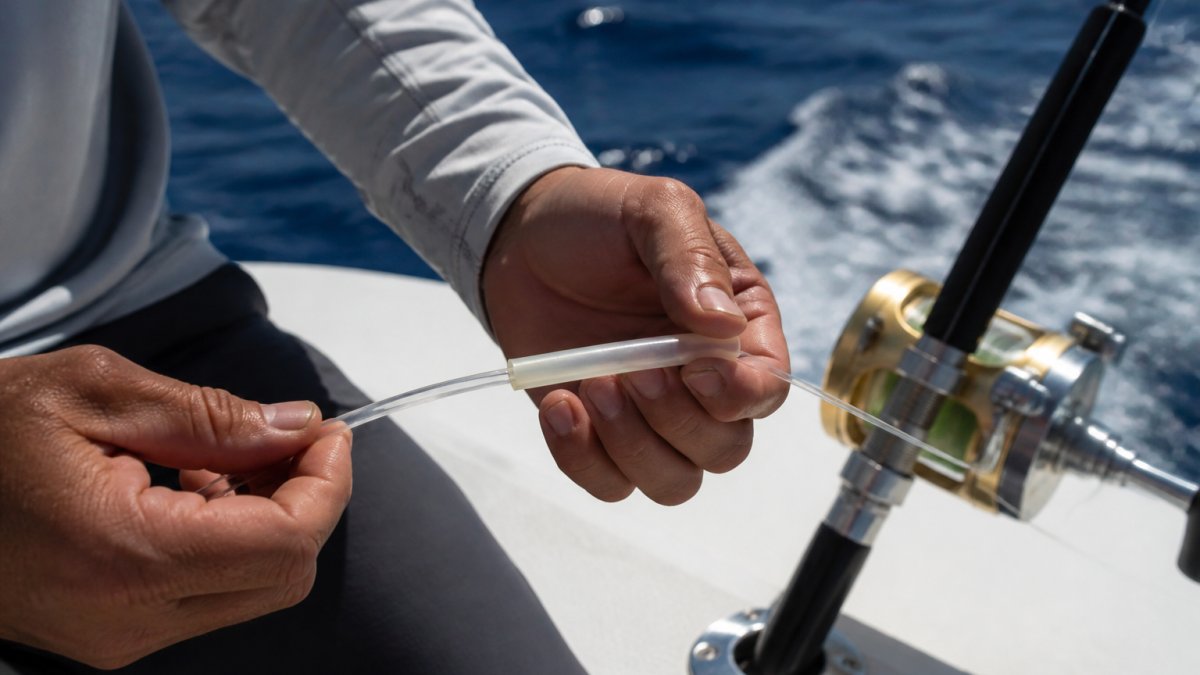
Titan Guard Chafe Tubing is manufactured in our family-owned factory in the Finger Lakes Region of New York from heavy-duty sleeving stock built for sport fishing.
Watch out: tubing that is too short or positioned above the contact zone does nothing.
Leader Length, Taper, and Knots That Hold Under Load
Leader length and taper determine how your rig casts, sinks, and absorbs shock.
For most offshore applications, a leader in the 15- to 30-foot range gives enough length to retie after abrasion without cutting into your main line.
Knot selection matters as much as material. The blood knot and surgeon's knot are the workhorses for joining leader sections; a double uni handles mismatched diameters better.
A common mistake is tying a beautiful connection knot and ruining it with a sloppy terminal knot. Trim tags close and check every knot after a fish.
Match Leader Protection to Your Boat, Budget, and Targets
Leader protection should scale with how you fish, not how much you can spend.
If you fish structure, prioritize abrasion resistance and heavier leader classes. If you fish clear water for pressured fish, prioritize fluorocarbon and lighter diameters.
Budget matters too. Fluorocarbon leaders cost more and get replaced more often.
Best for: anglers who retie often and want to stop cutting back damaged leaders. Skip if: you never fish around teeth or structure and your leaders already last multiple seasons.
Ordering Chafe Tubing for Your Next Offshore Trip
Ordering leader protection before a trip beats improvising at the dock.
Stock a range rather than a single size. A leader dispenser or organizer box with labeled sections keeps leaders sorted by pound test and length, so you are not digging through coils in a rolling sea.
If you have run the same leader setup for years without trouble, you are not wrong to trust it, you are one bad contact point away from finding its limit. Sleeving is cheap insurance against that day.
Frequently Asked Questions
Do you always need a leader on a saltwater fishing line?
Not always, but most saltwater setups benefit from one. A leader adds abrasion resistance against reefs, wreck structure, and rough scales, and it gives sharp-toothed fish like tuna and wahoo something tougher to cut through than braid. In clear water, a fluorocarbon leader also cuts visibility near the lure. The exceptions are light inshore work where line shyness is not a factor and heavy braid is already abrasion-resistant. For offshore big game, a leader plus some form of leader protection is standard practice.
How do you protect a monofilament leader from abrasion?
Three habits matter most. First, inspect the leader after every fish and trim or replace any section that feels rough. Second, keep the leader off structure during the fight by steering fish away from the boat, props, and reef edges. Third, add a physical barrier such as chafe tubing over the section that contacts teeth, gill plates, or the rod tip. Tubing takes the wear so the monofilament leader abrasion resistance is not tested directly. Replace the tubing when it looks scuffed or flattened.
What size leader should I use with 20-pound braid?
For 20-pound braid, a leader in the 20 to 30-pound test range is a common starting point, with 30-pound fluorocarbon giving extra abrasion margin around structure. Match the leader diameter to the situation rather than the braid alone: open water and leader-shy fish favor the lighter end, while reefs and inlets call for the heavier end. A fishing leader size chart is a starting reference, not a rule. Check knot seating and drag settings before you commit.
When should you replace a saltwater fishing leader?
Replace it when you can feel nicks, flattening, or roughness running a thumb along the line, when the leader has rubbed structure during a fight, or when it has landed several fish with teeth. Sun exposure and salt also degrade monofilament over time, so retire leaders that have sat rigged for weeks. Chafe tubing should be swapped whenever it looks scuffed or compressed. A fresh leader costs far less than a lost trophy fish.
Is chafe tubing overkill for a weekend angler?
It depends on what you chase. If you fish reefs, wrecks, or inlets where leaders rub structure, tubing is cheap insurance even on weekend trips. If you target sharp-toothed species like tuna or wahoo, it earns its place quickly. Anglers casting lures in open water with light leaders may not need it. The practical test is simple: if your leader keeps failing at the same spot, add protection there rather than sizing up the whole leader.
Will chafe tubing fit a wind-on leader system?
Chafe tubing is designed to slide over monofilament leader sections, so it works with wind-on systems as long as the tubing inner diameter matches your leader diameter and you install it before final connections. Slide the tubing onto the leader, position it over the section that takes the most wear, and secure it so it stays put during the fight. Check fit on a short test section before rigging for a trip.
Your next trophy fish will test the weakest part of your rig, and it will do it when the deck is moving and the clock is running. Titan Guard Chafe Tubing gives you heavy-duty sleeving made in our family-owned factory, protection against abrasion and sharp teeth, and practical packaging that works for charter captains and weekend anglers alike. Get started with Titan Guard Chafe Tubing and rig your leaders with the confidence that the contact point is covered.
