

Rigging Tips for Big Game Fishing: 2026 Guide
Table of Contents
- Leader Material and Pound Test: The Foundation of Every Rig
- How to Crimp Monofilament Leaders for Maximum Knot Integrity
- Preventing Line Abrasion in Big Game Fishing with Chafe Gear
- Hook Selection, Bait Presentation, and Rigging for Specific Species
- Deep Drop and Kite Fishing Setups for Offshore Angling
- Offshore Fishing Gear Maintenance Checklist and Troubleshooting Rigging Failures
- Frequently Asked Questions
Last Updated: September 25, 2026
Leader Material and Pound Test: The Foundation of Every Rig
Most offshore rigging failures trace back to one decision made before anything touches the water: leader material and pound test. Get it wrong and no amount of crimping skill or chafe protection will save the connection.
A practical starting point many crews use:
- Tuna under 100 pounds: 80-100 lb mono
- Tuna over 100 pounds: 130-200 lb mono
- Billfish: 150-400 lb depending on species and technique
How to Crimp Monofilament Leaders for Maximum Knot Integrity
Learning how to crimp monofilament leaders correctly produces connections that hold at or near the line's rated breaking strength, which knots rarely achieve on heavy mono. The crimp spreads load across a longer section of line instead of concentrating stress at one bend point.
The basic process:
- Thread the crimp sleeve onto the leader
- Pass the line through the hook eye or swivel
- Route the tag end back through the sleeve
- Position the sleeve so both line sections sit parallel
- Compress with a crimp tool using steady, full pressure
- Inspect for even compression and no line damage
Crimp Sleeve Sizing and Crimp Tool Selection
Crimp tools come in two types: hand crimpers for lighter leaders and heavy-duty crimpers for leaders above roughly 200 pounds. The tool must match the sleeve size, not just the line, a mismatch produces partial crimps that fail under load.
Crimping vs. Knot Tying: When to Use Each
Use crimps for leaders above 80 pounds and any connection needing consistent, repeatable strength. Knots still work for lighter leaders and quick field repairs. Crimps take longer to set up but deliver more predictable results on heavy tackle.
Preventing Line Abrasion in Big Game Fishing with Chafe Gear
Preventing line abrasion in big game fishing is where most trophy fish are lost. A leader that tests perfectly on the dock can fail in seconds when it rubs a fish's bill, gill plate, or the boat's rub rail.
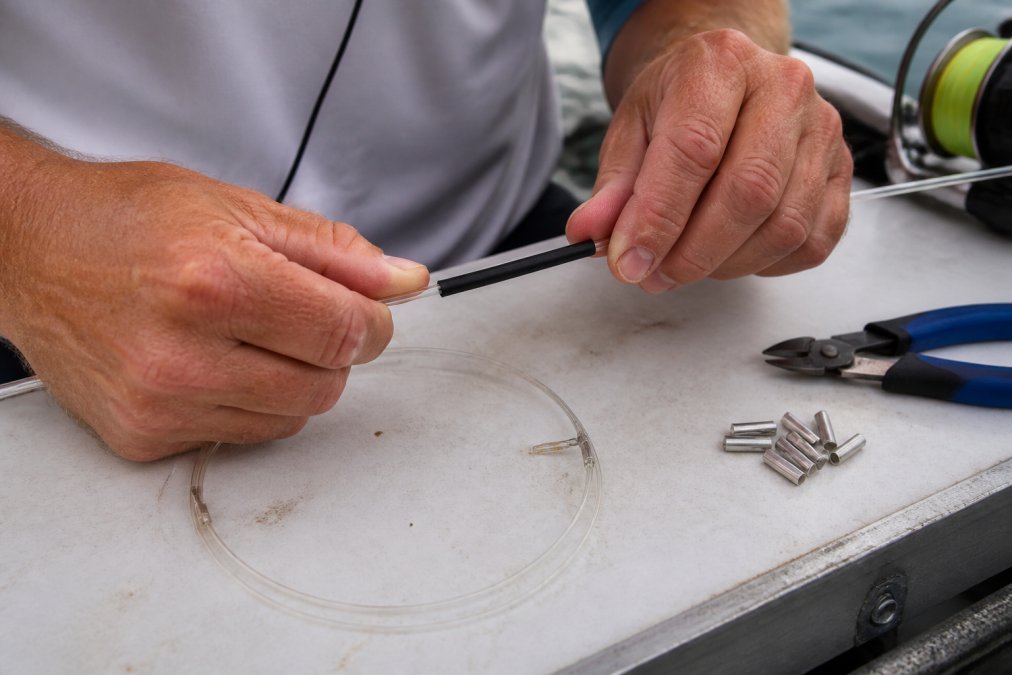
Chafe Tubing and Anti-Chafe Protection for Wind-On Leaders
Wind-on leaders create a splice where the main line meets the leader, and that splice is vulnerable. Anti-chafe tubing over the splice protects it from wear during repeated trips, cheap insurance against failure at the worst moment.
Hook Selection, Bait Presentation, and Rigging for Specific Species
Generic offshore rigging advice fails because a blue marlin, a yellowfin tuna, and a wahoo attack a bait in three different ways. Hook gap, wire diameter, leader length, and hookset timing all change with the target.
Blue Marlin and White Marlin
Billfish are billed, not teethed, so abrasion comes from the bill and the leader rubbing the fish's flank during the fight, not a bite. That changes the rig:
- Hooks: Non-offset circle hooks sized to the bait, commonly 8/0 to 10/0 for horse ballyhoo or skipjack. J-hooks still have a following for live-bait pitch rigs, but circle hooks dominate because they set in the corner of the mouth and reduce gut-hooking.
- Leader: 150-400 lb mono depending on fish size and technique. Wind-on leaders let a mate handle the fish at the boat without a long leader to manage.
- Hookset: Do not swing. Let the fish load the rod and come tight on its own. A hard hookset on a circle hook pulls it straight out of the mouth.
- Bait presentation: A bait that spins or trails sideways gets rejected. Bridle-rig a ballyhoo through the eye sockets with waxed thread or a small rubber band so the hook rides free of the bait's body.
Yellowfin and Bluefin Tuna
Tuna have crushing teeth and gill plates that shred leaders, so abrasion protection matters more here than almost anywhere else offshore.
- Hooks: Wide-gap circle hooks for live bait; heavy J-hooks for chunking and chunk-and-wind. Match gap to bait size, too wide and the bait masks the point.
- Leader: 80-100 lb mono for fish under 100 lb; 130-200 lb for fish over 100 lb. Fluorocarbon earns its cost in clear water and pressured fish.
- Hookset: On a circle hook, come tight and wind, no swing. On a J-hook with chunk bait, a firm sweep sets the point.
- Bait presentation: A live bait should swim down and away, not spiral. If it spins, the hook is too heavy or the bridle is off-center.
Wahoo
Wahoo are the exception: they bite through leaders, so wire is not optional.
- Hooks: Single or treble, sized to the lure. Many crews run a single inline hook for cleaner releases.
- Leader: Light single-strand wire (typically 30-60 lb) or heavy fluorocarbon for high-speed trolling. Wire costs some strikes in clear water but saves the fish you do hook.
- Rigging: High-speed trolling lures need a leader long enough to survive the strike and short enough to keep the lure tracking straight. A swivel between the wire and the mono leader prevents line twist at speed.
Dolphinfish (Mahi) and King Mackerel
- Mahi: Light leaders (40-80 lb), small circle or J-hooks, and a bait that skips naturally. Mahi have soft mouths, so a hard hookset tears out.
- King mackerel: Wire leader is mandatory, kings shear through mono. A stinger rig with a treble trailer behind a single hook improves hookup rates on short-striking fish.
Live Bait vs. Artificial Lure Rigging for Tuna and Billfish
Live bait rigging favors lighter leaders and smaller hooks for a natural swim. Artificial lure rigging allows heavier leaders and larger hooks because the lure's action masks the hardware. Trolling lures need leaders long enough to survive a strike without the fish reaching the main line.
Deep Drop and Kite Fishing Setups for Offshore Angling
Deep drop and kite fishing setups demand rigs built for two very different problems. Deep drop rigs fight pressure, current, and the long retrieve from depth, so leader connections must survive sustained load. Kite rigs face the opposite challenge: keeping a bait at the surface with minimal hardware between you and a striking fish.
Deep Drop Rigging
At 1,200 feet, every component is under load for the entire retrieve. A crimp that holds at the surface can creep under sustained pressure, and a leader that rubs a rock or wreck tears off a fish you never see.
- Main line: Braid is standard because it has near-zero stretch and thin diameter, which reduces drag in current. A common setup is 65-100 lb braid.
- Leader: Heavy mono or fluorocarbon, typically 100-200 lb, long enough to protect against structure and teeth. Some crews run a short wire section above the hook for grouper and tilefish.
- Rig style: A chicken rig (also called a dropper-loop rig) with two or three hooks on short dropper loops above a heavy sinker. Sinker weight is dictated by current, 16 to 48 oz is common, and going too light means the rig never reaches bottom.
- Hooks: Circle hooks sized to the bait, with the point exposed. A bait that covers the point on a deep drop is a missed fish, because you cannot feel a soft take at depth.
- Failure points: The dropper loop is the weak link on most chicken rigs. Inspect every loop before each drop, and replace the rig after any fish that fought hard enough to stress the connections.
Kite Fishing Rigging
A kite keeps a live bait dancing at the surface, where marlin, sailfish, and king mackerel expect an easy meal. The rig is deliberately light so the bait skips and swims naturally.
- Kite line: Typically 80-130 lb braid or Dacron, run from the rod to the kite. The kite line carries the bait out; the fishing line runs from the rod to a release clip on the kite line.
- Release clip: The clip holds the fishing line at the surface until a fish strikes, then releases the line so the fish can run. Clip tension must match the bait size, too tight and the bait can't swim, too loose and the clip releases on a wave.
- Leader: Light enough for the bait to skip naturally but heavy enough to survive a surface strike. For sailfish and small marlin, 50-80 lb mono is common; for larger fish, step up to 100-130 lb.
- Hooks: Circle hooks for live bait, bridled through the bait's back or nose so it swims upright. A bait that rolls on the surface won't get eaten.
- Failure points: The release clip is the most common failure, either it doesn't release on the strike (and the fish feels the kite) or it releases prematurely (and the bait sinks). Test clip tension before every deployment.
Troubleshooting Rigging Failures
Most rig failures leave a signature. Read the failure point before re-rigging:
- Crimp slipped: Sleeve size or crimp tool was wrong. Re-check the manufacturer's chart against your leader diameter.
- Leader broke mid-section: Abrasion. Add or reposition chafe tubing at the wear point.
- Leader broke at the hook: The hook eye cut the leader, or the knot/crimp was damaged. Inspect the eye for burrs and re-rig.
- Hook pulled: Hook gap was wrong for the bait, or the hookset was too aggressive on a circle hook.
- Line twist: A swivel is missing or seized. Add a quality swivel between the leader and the main line.
- Bait spins: Hook is too heavy, bridle is off-center, or the leader is too stiff for the bait.
Offshore Fishing Gear Maintenance Checklist and Troubleshooting Rigging Failures
An offshore fishing gear maintenance checklist prevents the failures that end trips early. Most rigging problems are visible before they cost you a fish, if you know where to look.
- Inspect every crimp for even compression and no slippage
- Check leader for nicks, cloudiness, or flat spots
- Verify chafe tubing is seated over splices and connections
- Test swivels for smooth rotation
- Replace any leader that contacted a fish's teeth
- Check hook points for sharpness and corrosion
- Confirm drag settings match the leader's rating
Storing Pre-Rigged Leaders and Environmental Impact of Rigging Materials
Store pre-rigged leaders coiled loosely in a dark, dry place away from direct sun. UV exposure degrades monofilament, and a leader that sat on an open deck all season is weaker than its rating suggests.
Frequently Asked Questions
What is the best leader material for big game fishing?
For big game fishing, monofilament leaders in 100- to 400-pound test are the standard for their stretch and shock absorption. Fluorocarbon leader material offers better abrasion resistance and invisibility but costs more and has less stretch. Many offshore anglers run a monofilament main leader with a fluorocarbon top shot for a balance of durability and stealth. Match leader strength to your target species and drag settings.
How do you properly crimp monofilament leaders for maximum strength?
Select a crimp sleeve that matches your leader diameter, thread the leader through the sleeve and hook eye, then insert the leader back through the sleeve. Use a crimp tool designed for your sleeve size and apply steady pressure. A properly crimped connection maintains leader strength better than a poorly tied knot in heavy monofilament.
What is the purpose of chafe tubing in big game rigging?
Chafe tubing, also called chafe gear, slides over monofilament leaders to protect them from abrasion against fish teeth, boat hardware, and rough skin. During long fights with tuna or billfish, the leader rubs against the fish's bill, gill plates, and tail. Chafe tubing absorbs that wear so the leader stays intact at the critical moment. It is especially valuable on wind-on leaders where splices need extra protection.
How often should you inspect your offshore fishing gear?
Inspect leaders, crimps, hooks, and swivels before every trip. Run your fingers along the leader to feel for nicks or rough spots. Replace any crimp that looks flattened or cracked. After each trip, rinse all terminal tackle with fresh water and dry it before storage. A full offshore fishing gear maintenance checklist should be run at least monthly during the season, and pre-rigged leaders should be retired after heavy use.
How do you prevent line abrasion when fighting large pelagic fish?
Use chafe tubing on your leader where it contacts the fish, and keep your drag set so the fish cannot take line freely against structure. Maintain steady line tension to reduce slack line that causes tangles and abrasion. Avoid letting the leader rub the transom or gunwale during the final stages of the fight. Inspect leaders after every fish and replace any section showing wear before the next drop.
What are the essential components of a big game trolling rig?
A trolling rig typically includes a main line, a wind-on leader, a crimped connection, a swivel, chafe gear, and a hook or lure. Trolling lures like skirted swimbaits run behind the leader, while live bait rigs use circle hooks or J-hooks. Match hook gap to bait size and use crimp sleeves rated for your leader diameter. A clean leader connection and proper drag settings round out the setup.