

Troubleshooting Monofilament Leader Breakage Issues
Table of Contents
- Why Your Monofilament Leader Keeps Breaking: Start With the Break Location
- Braid to Mono Leader Knot Failures: Why the Connection Slips
- How to Inspect Monofilament Fishing Line Before Every Trip
- Fishing Line Abrasion Damage: Causes and Prevention
- How to Tie and Test Monofilament Leader Knots That Hold
- Matching Leader, Main Line, Rod, and Drag to Prevent Breakage
- Conclusion: Stop Breakage Before It Costs You a Fish
- Frequently Asked Questions
Last Updated: October 16, 2026
Why Your Monofilament Leader Keeps Breaking: Start With the Break Location
Most anglers blame the fish. But a monofilament leader rarely fails at random, it fails at a weak point, and the exact spot where it broke tells you what went wrong.
A monofilament leader is the clear nylon line connecting your main line to your hook, lure, or bait, adding a stretch buffer and abrasion resistance at the business end of your rig.
So before you retie anything, look at where the line parted. That one detail narrows the problem fast.
| Break Location | Likely Cause | First Fix |
|---|---|---|
| Clean curl at the knot | Knot failure or slippage | Retie, wet, seat slowly |
| Frayed end near hook | Abrasion or teeth | Shorten leader, add chafe protection |
| Mid-leader snap | Damaged or aged line | Inspect and replace |
| Line guide contact | Rod tip or guide wear | Check guides for cracks |
Break at the Knot: Knot Failure Signs
A break at the knot usually leaves a tight curl or "pig tail" at the end of the line, meaning the knot slipped or the line broke at the bend where it seats. Common causes:
- Dry line that wasn't wetted before tightening
- Tightening too fast, which builds heat and weakens the mono
- Too few wraps for the line diameter
Break at the Hook or Lure: Abrasion and Teeth Damage
A frayed, fuzzy end near the hook points to abrasion or teeth. Tuna and billfish have rough mouths and sharp teeth that saw through unprotected mono, and reef and wreck fishing adds rock, coral, and structure to the mix.
If the break sits at the hook eye or lure, the leader rubbed against something hard during the fight. Shorten the leader, retie, and add protection at the contact point.
Braid to Mono Leader Knot Failures: Why the Connection Slips
The braid-to-leader connection is the weakest link in most offshore setups. Braid is slick and thin, mono is stiff and has memory, and getting them to grip takes the right knot and careful seating.
Two knots cause most of the trouble: the FG knot and the double uni.
FG Knot Slippage and Half Hitch Problems
The FG knot passes through guides cleanly but slips when it isn't finished properly. The wraps must bite into the braid and the half hitches lock everything in place; skip them or tie them loose and the connection slides apart under load.
If your FG knot slips, check three things: the number of wraps, how hard you pulled the wraps tight, and whether the half hitches were seated firmly against the wraps.
Double Uni Knot Issues With Stiff Monofilament
The double uni knot is easy to tie, which is why so many anglers use it. It struggles with stiff monofilament. Thick, wiry mono doesn't cinch down evenly, so the coils stay loose and slip under pressure.
If you fish heavy mono, either go up in wrap count or switch to a knot built for mismatched line diameters. For lighter leaders, the double uni still works well.
How to Inspect Monofilament Fishing Line Before Every Trip
A two-minute inspection catches most breakage before it happens, making how to inspect monofilament fishing line one of the highest-value habits in offshore fishing.
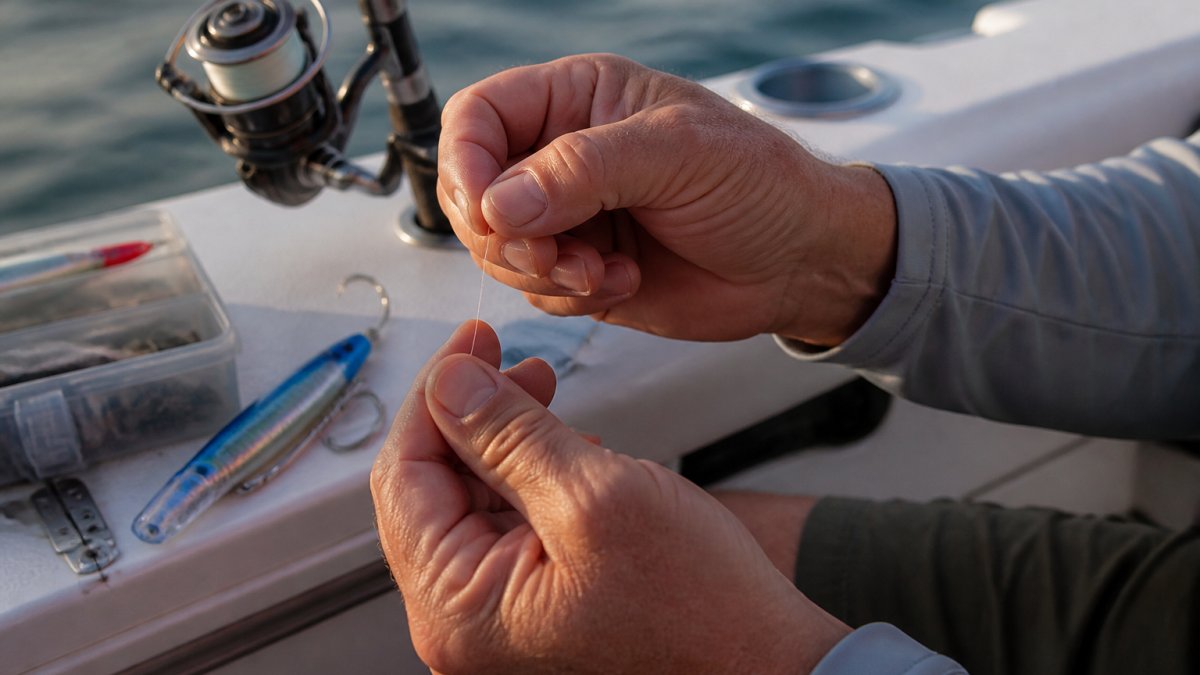
Run the leader through your fingers from the hook back to the connection, feeling for nicks, flat spots, and rough patches, then check it against the light for cloudy or discolored sections.
- Feel for nicks and rough spots
- Look for cloudiness or discoloration
- Check for fraying near the hook and swivel
Line memory and stiffness are also clues. Mono that stays coiled or feels brittle has aged out.
Fishing Line Abrasion Damage: Causes and Prevention
Fishing line abrasion damage is the slow wear that turns a strong leader into a weak one, building up over casts, fights, and contact with hard surfaces.
The fix is inspection, protection, and knowing where your line touches the world.
Where Abrasion Happens: Guides, Cover, and Fish Teeth
Abrasion shows up in three main places:
- Rod guides and tips: A cracked or rough guide shaves the line on every cast. Check guides with a cotton swab; snags mean it needs replacing.
- Cover and structure: Rocks, wrecks, pilings, and grass all wear mono down. In heavy cover, fish a heavier leader and check it often.
- Fish teeth and mouths: Tuna and billfish teeth saw through unprotected line during a fight. This is where chafe protection earns its place.
How to Tie and Test Monofilament Leader Knots That Hold
Generic knot advice is everywhere, but monofilament behaves differently from fluorocarbon and braid, and the numbers you tie to should change with diameter. Here is a mono-specific approach plus a controlled dock test.
Pick the Knot for the Job
- Improved clinch or Palomar for tying mono directly to a hook, swivel, or lure eye. The Palomar is stronger on mono and the better choice above roughly 30 lb test, where a clinch knot's coils struggle to seat evenly on stiff line.
- Double uni for mono-to-mono or light mono-to-braid. It is forgiving and easy to tie in the wind.
- FG knot for braid main line to a mono leader. It is the slimmest option through guides, but demands more wraps and a harder final seating pull than most anglers give it.
Wrap Counts That Actually Match Mono Diameter
Wrap count is where most breakage starts: too few wraps and the knot slips, too many and the coils stack instead of biting down evenly. A common pattern among experienced saltwater anglers:
| Mono diameter | Clinch / improved clinch | Double uni (per side) |
|---|---|---|
| 20-30 lb | 5-6 wraps | 5-6 wraps |
| 40-60 lb | 4-5 wraps | 4-5 wraps |
| 80-130 lb | 3-4 wraps | 3-4 wraps |
Heavy mono needs fewer wraps, not more. Thick, wiry line cannot cinch a tall stack of coils flat, so extra wraps create loose loops that slip under load.
Wet, Seat, and Tighten in the Right Order
- Wet the knot with saliva or water before tightening. Dry mono generates friction heat as the coils slide, and heat permanently weakens nylon.
- Seat the knot first by pulling the standing line and tag end apart with moderate pressure until the coils stack neatly. Do not yank.
- Tighten slowly and evenly, letting the coils walk down toward the eye or connection. Fast, jerky tightening produces the telltale pigtail curl at the break.
- Snug the knot against the eye or connection so it cannot shift under load.
- Trim the tag end to roughly 1/8 inch, long enough to confirm the knot did not slip, short enough not to catch a guide.
A Controlled Knot-Strength Test You Can Run at the Dock
Most anglers "test" a knot with a quick tug, which tells you almost nothing. A repeatable test looks like this:
- Tie the knot you want to evaluate on a fresh length of your actual leader material.
- Hook the standing line to a fixed anchor, a cleat, a trailer hitch, a heavy bench, and the tag end to a spring scale or luggage scale rated well above your line weight.
- Pull smoothly and steadily until something gives. Note the reading and where it broke: at the knot, beside the knot, or along the line.
- Repeat three to five times with the same knot and material. One break tells you nothing; a pattern does.
What the results mean:
- Breaks at the knot, consistently, well below line rating: the knot is the weak point. Change knots or add wraps.
- Breaks just beside the knot: the line is being cut by the knot's own bend radius, or is damaged at that spot. Inspect the leader and consider a knot with a gentler entry angle.
- Breaks along the leader, away from the knot: the knot is fine and the line itself is the problem, age, UV, abrasion, or a bad spool.
A knot that holds 80-90% of the line's rated strength is doing its job. One that fails at half the rating tells you exactly where to focus.
The Mistakes That Show Up Most Often
- Tightening a dry knot and feeling it "grab", that grab is friction heat, not a good seat.
- Trimming the tag end flush so you cannot tell whether the knot slipped after a fish.
- Reusing a knot after a hard fight. Mono takes a set at the knot; cut it off and retie.
For big game setups, protect the finished leader at the teeth and structure contact points. Titan Guard Chafe Tubing makes heavy-duty sleeving that guards monofilament leaders against abrasion and sharp fish teeth. It is made in the USA in our family-owned factory in the Finger Lakes Region of New York.
Matching Leader, Main Line, Rod, and Drag to Prevent Breakage
Knot advice only goes so far. Many break-offs happen because the leader, main line, rod, and drag work against each other, and no knot can fix a system set up to fail.
The Leader-to-Main-Line Ratio
A common rule of thumb is keeping the leader at or below the main line's rated strength, so the leader is the intentional weak link. In practice, saltwater anglers often run a leader heavier than the braid main line, braid is thin and the leader needs abrasion resistance, and rely on the drag to protect the system.
- Mono main line with mono leader: keep the leader at or slightly below the main line rating. The leader breaks first, and you keep your main line.
- Braid main line with mono leader: the leader is usually heavier than the braid's rated strength, because braid's small diameter and low stretch change how load is distributed. The drag becomes the real safety valve.
Setting Drag to Protect the Leader
Drag is the most useful tool for preventing leader breakage, yet most anglers set it by feel. A repeatable method:
- Set the drag to roughly one-quarter to one-third of the leader's rated strength. On a 40 lb leader, that is about 10-13 lb of drag.
- Use a spring scale or luggage scale on the leader and pull until the drag slips. Adjust until the reading matches your target.
- Check the setting at strike and at full, many reels gain significant drag as the spool empties, and a fish near the end of a long run can push the leader past its limit.
- Recheck after every trip. Drag washers settle, and a setting that was right last month may be off today.
A drag set too tight sends every surge to the weakest point; too loose lets a fish take line into structure, where abrasion finishes the job.
Rod Action and Hook-Set Force
Rod action decides how much shock reaches the leader. A fast, stiff rod transmits nearly all hook-set force and every head shake into the line, while a moderate or slow action rod bends deeper, absorbing shock and giving the leader a margin.
- Fast, heavy rods suit heavy leaders and short, powerful hook sets. They punish light mono.
- Moderate or parabolic rods are more forgiving on mono leaders and the better match for 20-40 lb leader.
- Hook-set force should match the leader, not the fish. A hard, sweeping hook set on 20 lb mono commonly breaks right at the knot; a firm, smooth lift is usually enough.
Where the System Breaks First
When a break-off happens, ask which component was the weak link:
- Leader breaks at the knot: knot or seating problem, see the knot section above.
- Leader breaks mid-length: abrasion, age, or a nick the inspection missed.
- Main line breaks: the leader was too heavy for the main line, or the drag was set above the main line's rating.
A Simple Pre-Trip System Check
- Confirm leader and main line ratings and write them on tape on the reel.
- Set drag with a scale at strike and at full, and note both numbers.
- Match rod action to the leader weight you plan to fish.
Do this once per trip and the break-offs that used to feel random start to look preventable.
Conclusion: Stop Breakage Before It Costs You a Fish
Break-offs are frustrating but almost always preventable. Start with the break location, fix the knot, inspect the line, and protect the contact points where teeth and structure do their damage.
At Titan Guard Chafe Tubing, we build heavy-duty sleeving made in the USA to guard monofilament leaders against abrasion and sharp fish teeth. Our family-owned factory ships fast, and our hassle-free returns make it easy to try.
Frequently Asked Questions
Why does my monofilament leader keep breaking?
Monofilament leader breakage usually traces back to one of four causes: knot failure from improper tightening, abrasion damage from rocks or fish teeth, line degradation from UV and age, or a mismatch between leader strength and drag pressure. Start by examining where the line broke. A curl at the break point suggests knot slippage, while a frayed end points to abrasion. Replace leaders showing nicks, cloudiness, or stiffness, and always wet knots before pulling them tight.
How can I tell whether a knot or the leader caused a break?
Look at the end of the broken line. A knot failure leaves a tight curl or pigtail just above the break, and the knot itself may be missing. Leader failure from abrasion shows a frayed, rough end. If the break is clean and mid-line, the mono likely snapped from load or a weak spot. Check your knots first, then inspect the rest of the leader for nicks and flat spots.
How do I prevent abrasion and fish-tooth damage to a monofilament leader?
Use chafe protection anywhere the leader contacts structure, guides, or teeth. Protective tubing slides over the leader at the hook end and absorbs abrasion from reef, wreck, and fish teeth. Shorten your leader in heavy cover, check it after every fish, and cut back any section showing roughness. For big game, a heavy-duty sleeve at the business end is the difference between landing a fish and losing it at the boat.
When should I replace a damaged monofilament leader?
Replace the leader immediately if you find nicks, flat spots, cloudiness, or stiffness. Monofilament degrades from UV exposure, heat, and repeated stress. Even without visible damage, swap leaders after a few hard-fought fish or at the start of each season. A quick test: run the line through your fingers. If it feels rough or has memory coils that won't relax, cut it off and tie a fresh one.